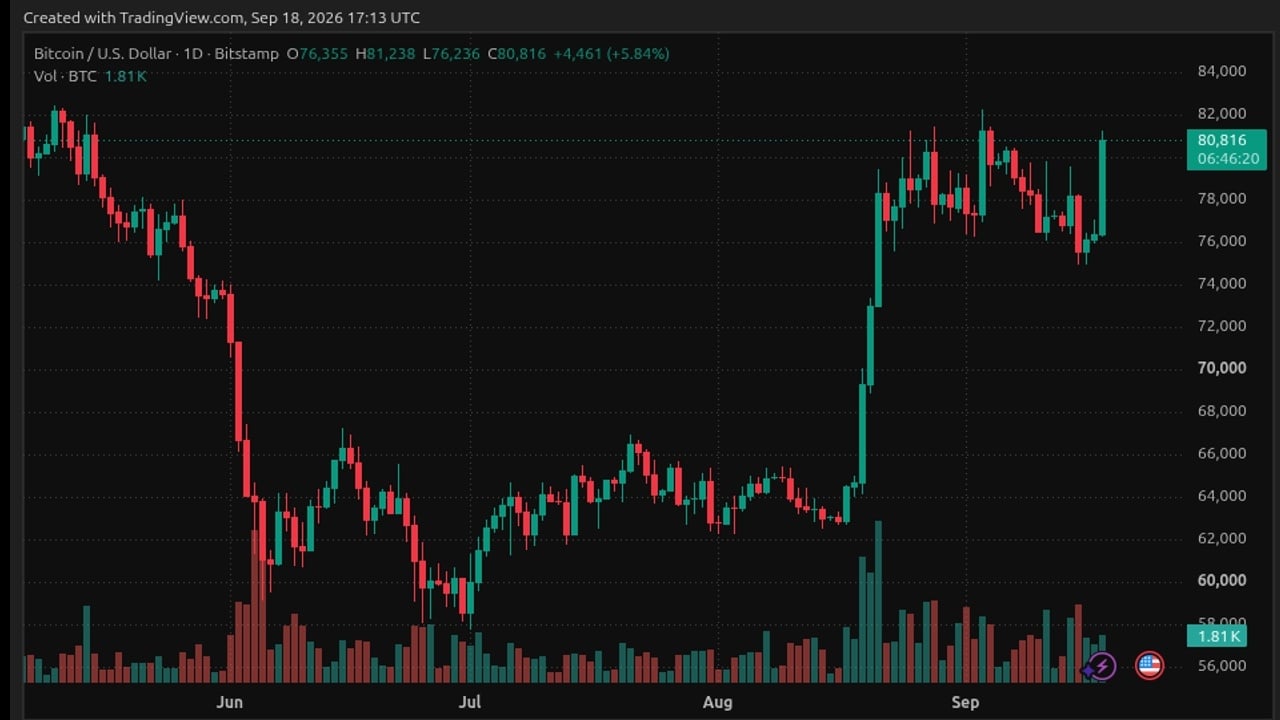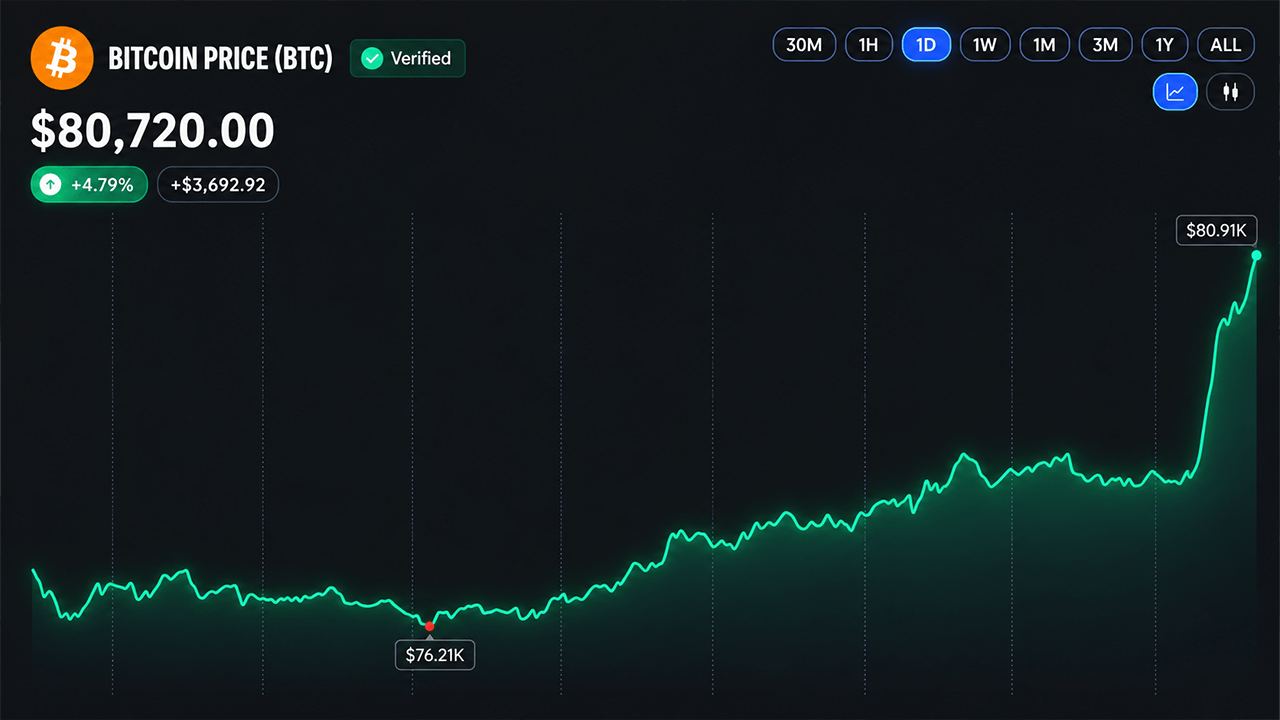
Bitcoin's price jumped from the mid-$76,000s to nearly $81,000 on Friday at 10:45 a.m. ET, reaching $80,935 after traders absorbed a failed U.S. Senate crypto vote and two central bank rate hikes during the week.
The sharp move was powered by forced liquidations rather than organic buying demand. Roughly $192 million in leveraged crypto positions were closed in one hour, with more than $183 million coming from short positions. When shorts are liquidated, traders must buy back the asset, which pushes prices higher and triggers additional liquidations—a cascade that accelerated bitcoin's breakthrough above $80,000 for the first time since September 7.
Week of Headwinds Reversed
Bitcoin had spent most of the week declining after the CLARITY Act failed to advance in the U.S. Senate on September 15, followed by the Federal Reserve's 0.25 percentage point rate increase on September 16. The cryptocurrency slipped toward $75,000–$76,000 as traders built short positions expecting further weakness.
The Bank of Japan's decision to raise its policy rate by 0.25 percentage points to 1.25% on Friday did not produce the market shock some feared. Instead, the move appeared to shift market sentiment. U.S. spot bitcoin exchange-traded funds recorded approximately $159 million in inflows on September 17, adding underlying demand as momentum traders and algorithms joined the rally.
Resistance Ahead
Bitcoin now faces resistance in the $81,700–$83,000 zone, with the 365-day moving average sitting near $81,700. Holding above $80,000 would position bitcoin to test this band next, while losing that level would put the upper $79,000s back into play.
The cryptocurrency remains well below its October 2025 all-time high near $126,200.