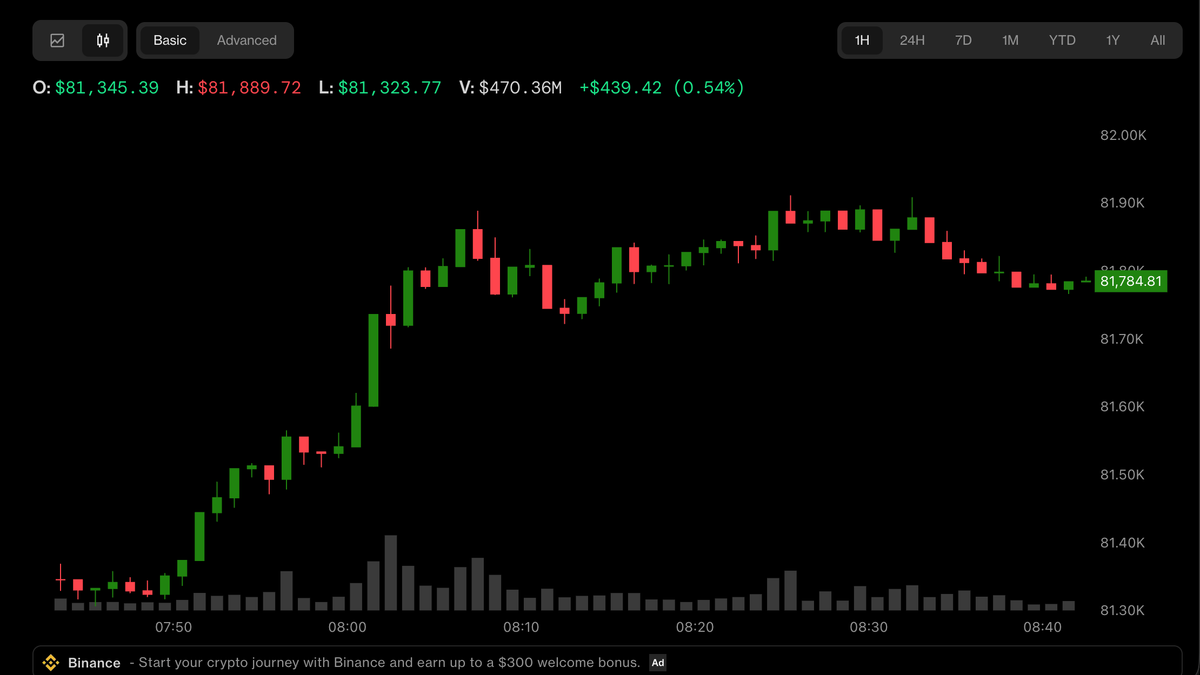
Bitcoin reached an intraday high of $82,108 before settling near $81,050, marking a 4.5% gain over the previous 24 hours according to CoinGecko data. The rally extends a broader upward trend that began in August.
Despite the price movement, Fidelity Digital Assets cautioned that the recent spike alone does not confirm the end of the bear market. Bitcoin posted its strongest monthly gain since November 2024 in August, while Ether and Solana showed even larger advances during the same period.
Diverging Views on Market Direction
Chris Kuiper, Vice President of Research at Fidelity Digital Assets, pointed to historical patterns where low volatility often precedes sharp upward moves—a pattern he says played out from June into late August. He noted that some traders monitor Bitcoin's four-year cycle theory, which suggests bear-market bottoms occur approximately four years apart. Based on the November 2022 low, this pattern would point to a possible bottom near November 2026.
Kuiper cautioned that this cycle has never repeated on a precise schedule and should not be used to time market entries. The cycle's low may have already formed in July, he added, or a fresh low could arrive later in the year.
Other analysts offered a more bullish assessment. Eric Crown argued in a recent call that the bear market had already ended in August.
Market Resilience and Fundamentals
Fidelity highlighted signs of market resilience, noting that recent negative headlines failed to push prices lower. It cited a hardware wallet security incident as an example of bearish pressure that did not materialize into selling pressure, suggesting sellers may have limited capacity to drive prices down further.
The firm pointed to growth in stablecoins and tokenized real-world assets—including bonds and real estate—as evidence that network fundamentals remained strong even as prices declined. Fidelity argued that adoption of digital assets and Bitcoin's price action are now moving back into alignment, with investors watching whether this relationship holds through the remainder of the year.
Separately, regulatory developments continued to unfold. The CLARITY Act, designed to clarify federal oversight of crypto, remained pending in the Senate with a voting deadline making quick passage unlikely. The SEC's Regulation Crypto Assets framework for early-stage crypto offerings also remained open for public comment.