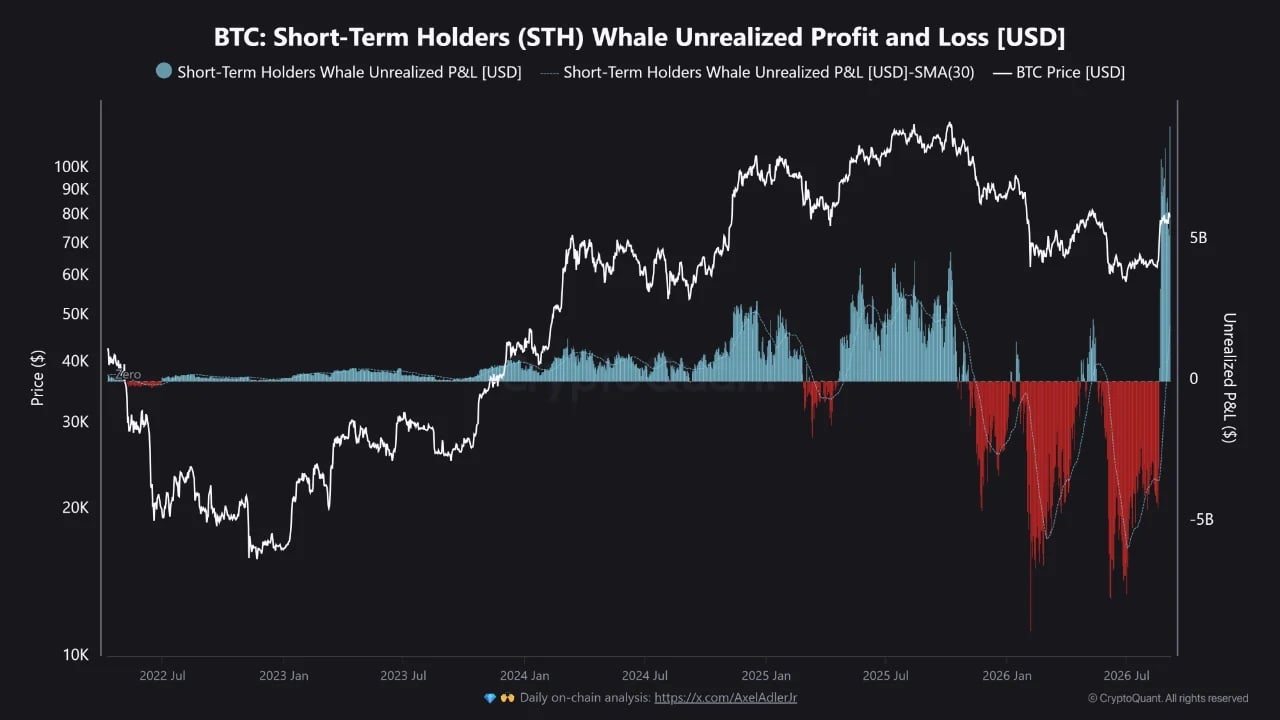
Short-term holder whale unrealized profit reached a record $9.07 billion on September 4, according to analysis from Cryptoquant published on September 7. The metric eased to $7.51 billion on September 5 as Bitcoin's price declined, but remained among the five highest readings in the metric's history dating to 2016.
The record gains occurred as Bitcoin climbed above $80,000, with all five highest readings in the chart's observed period occurring during the previous two weeks. Cryptoquant contributor IT Tech described the figure as paper gains held by large wallets that acquired Bitcoin within recent months.
Profit Concentration and Selling Risk
Unrealized profit represents the difference between an asset's current market value and its onchain cost basis before sale. It measures profit available on paper rather than completed transactions. Short-term holder whale unrealized profit and loss tracks coins that moved recently and are held outside exchange reserves.
According to the analysis, elevated profitability may increase the risk of whale selling. The contributor noted that "a cohort sitting on a record paper gain can turn into sellers the moment price wobbles, and STH whales are historically the fastest to take profit when it's available."
Separate onchain data placed the broader short-term holder cost basis near $71,000 in late August, while a dense accumulation area between $62,000 and $65,000 formed a deeper support zone below the market.
Price Action and Support Levels
Bitcoin traded between approximately $79,300 and $79,500 on September 7 after retreating from an intraday high of $80,537. Immediate support was placed around $79,013, with the $76,300 to $77,000 region representing the next lower support area if that boundary failed.
Selling activity was not limited to recently acquired holdings. A wallet created in 2016 moved 1,260.77 BTC worth more than $100 million, while nearly 75 physical Casascius bitcoins were redeemed during the first six days of September.
Market Structure Under Pressure
The analysis presented the market as facing tension between established cost-basis support and profits that could become sell-side supply. According to the contributor, "the cost basis structure argues the floor under this rally is real, but the unrealized gain sitting on top of it argues that same floor is now being tested by its own success."