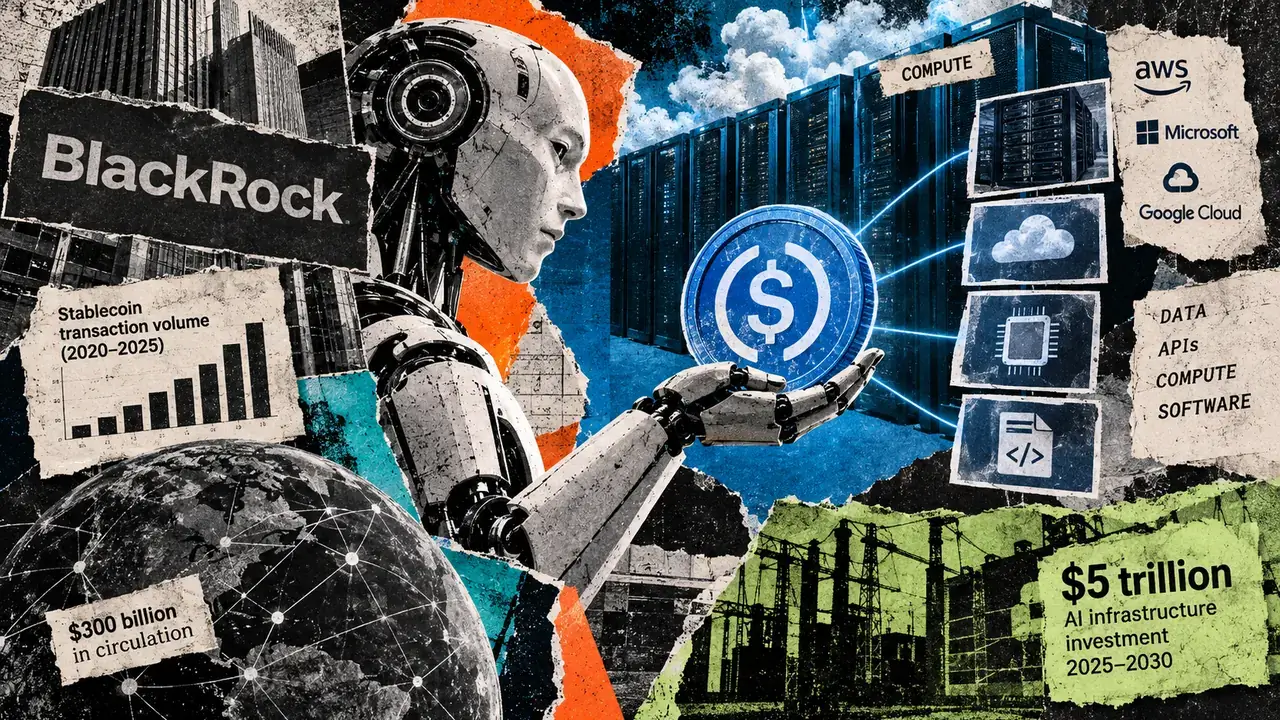
BlackRock has outlined a potential new use case for stablecoins: autonomous AI systems that conduct transactions continuously without human approval. The world's largest asset manager suggests that increasingly autonomous software could independently purchase data, software access, and computing resources, creating a novel source of transaction demand for digital assets.
The analysis appears in BlackRock's report The Machine-Native Economy, which argues that artificial intelligence could fundamentally change who initiates economic activity. Rather than humans making individual payment decisions, software could execute thousands of small transactions to complete a single task.
Current Stablecoin Activity
Stablecoins already show significant adoption, with more than $300 billion in circulation and approximately $11.2 trillion in adjusted transaction volume in 2025, according to BlackRock. The firm calculated that this volume grew at an 80% compound annual rate between 2020 and 2025, compared with roughly 8.5% annual growth for the U.S. Automated Clearing House (ACH) network, which processed about $93 trillion last year.
BlackRock cautioned against directly comparing stablecoin activity with traditional card networks, noting that Visa and Mastercard measure transactions differently.
Machine-Native Payments
The potential shift lies in transaction patterns rather than current volumes. AI agents could pay repeatedly for individual API calls, data feeds, or units of computing power—transactions potentially worth fractions of a cent occurring around the clock. This payment behavior differs markedly from traditional card purchases or bank transfers designed around human customers.
Stablecoins offer advantages in this scenario because software can hold them in programmable wallets and settle transactions without requiring human approval for each payment.
Competing Infrastructure
Multiple payment protocols are already being developed for machine commerce. Coinbase's x402 protocol enables services to demand payment through the web before returning data or resources, with agents able to transfer USDC and receive services without human intervention. Stripe and Tempo are developing the Machine Payments Protocol for settling transactions through stablecoins or traditional methods, while Google and Visa are working on standards around agent identity and authorization.
Traditional payment networks can adapt to autonomous software, particularly where agents transact with established businesses. Stablecoins may have an advantage where payments become especially small, frequent, or native to software.
Computing Infrastructure Market
BlackRock expects the same payment architecture to extend to one of AI's largest expenses: computing power. Cumulative investment in AI infrastructure could exceed $5 trillion between 2025 and 2030, while combined revenue from Amazon Web Services, Microsoft's Intelligent Cloud business, and Google Cloud is forecast at approximately $1.1 trillion by 2030.
AI agents could compare computing providers by price, hardware, location, and performance; purchase capacity for specific tasks; and settle costs automatically. This could create a recurring machine-to-machine transaction loop without human intervention at each stage.
Potential Financial Markets
BlackRock suggests that standardized claims on computing capacity could eventually be traded or pledged as collateral, while futures markets could allow buyers and sellers to hedge changes in compute costs. Such markets would require standards accounting for differences between chips, energy prices, locations, and performance.
BlackRock notes that this portion of the analysis remains largely prospective, as agentic payment activity is still nascent and traditional financial companies are building their own infrastructure for autonomous commerce alongside crypto firms.
Competing Systems
The near-term competition centers on establishing which wallet and payment infrastructure machines will use. Stablecoin issuers seek their tokens to become the default settlement asset for software, while payment protocols aim to become the standard agents use to request and pay for resources. Blockchain networks face the task of ensuring higher stablecoin throughput translates into demand for their economic assets, while traditional payment networks have incentives to keep activity on existing rails.