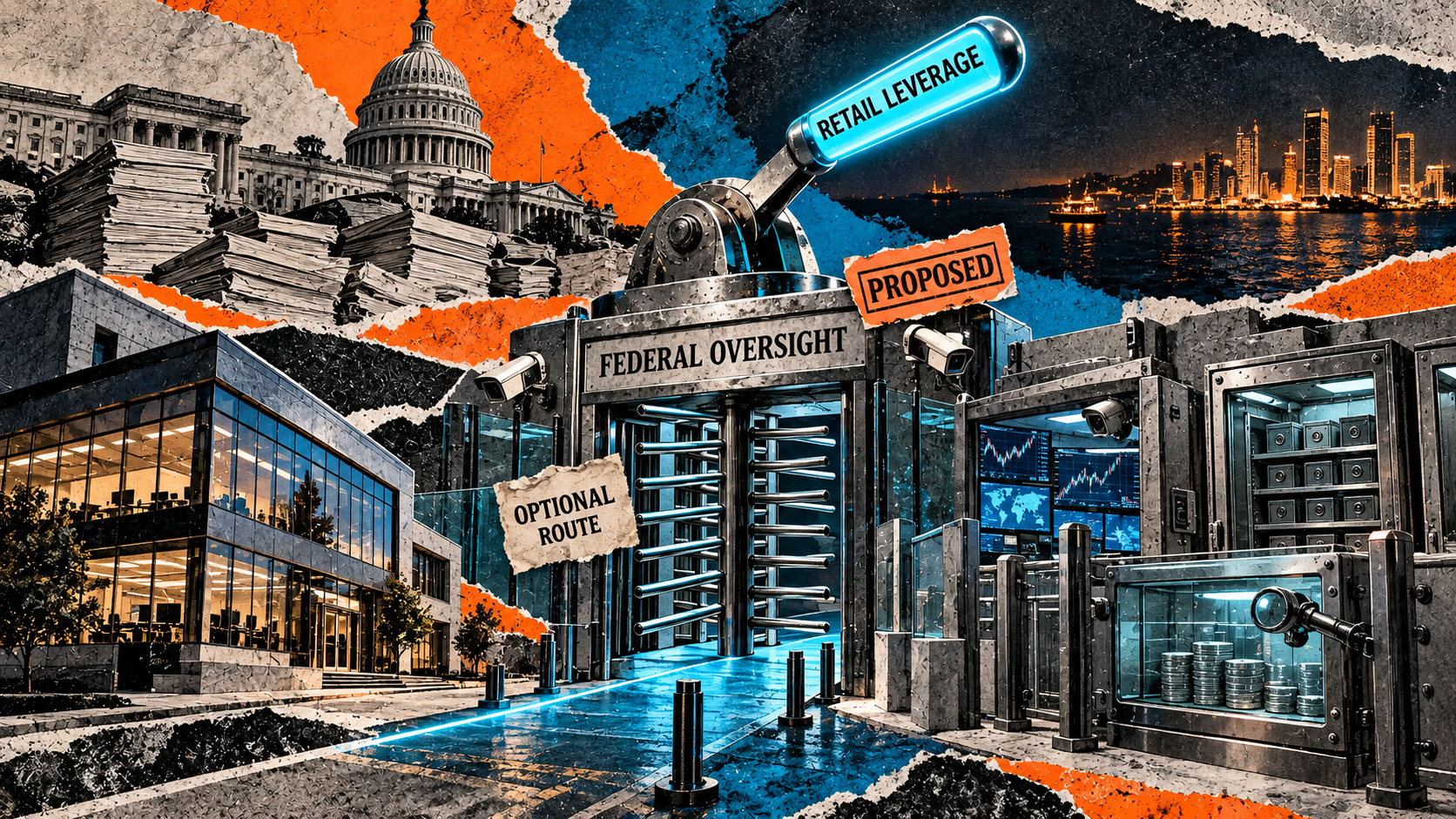
The Commodity Futures Trading Commission (CFTC) is creating a federal route for US crypto exchanges to offer retail leverage trading while Congress remains stalled on broader market-structure legislation.
On October 5, the CFTC opened rulemaking for Regulation Crypto Asset Transactions (CTX) and Regulation Crypto Asset Markets (CAM), which would establish a national framework for platforms offering retail customers margined, leveraged, or financed crypto trading.
A Voluntary Path to Federal Oversight
Participation in the new framework would remain optional for crypto exchanges. The CFTC acknowledged it cannot compel the broader crypto market to use CFTC-regulated venues without congressional action. The primary incentive is access to leveraged products that state money-transmitter licensing alone does not provide.
The initiative creates three regulatory pathways depending on what an exchange offers US customers: ordinary spot exchanges would remain primarily under state licensing, platforms offering leveraged or financed retail crypto transactions could seek federal registration under the new framework, and venues offering futures and derivatives would continue under existing designated contract market rules.
Regulatory Requirements and Trade-Offs
Exchanges entering the federal framework would face substantial requirements modeled on designated contract market standards. These include rules governing financial integrity, surveillance, conflicts of interest, and operational safeguards.
The CFTC is also considering crypto-specific requirements, such as assessing token concentration, distribution methods, vesting schedules, and other factors when determining whether an asset can be traded without being readily susceptible to manipulation. Platforms holding customer assets would face proof-of-reserves requirements.
Customer trades would be intermediated through registered futures commission merchants, bringing customer accounts and property under requirements covering capital, disclosures, and segregation. This involvement would also bring customer-facing activity within Bank Secrecy Act obligations, including anti-money laundering controls and customer identification procedures.
Addressing Offshore Competition
Leveraged trading and perpetual contracts have helped offshore venues attract active traders and generate substantial volumes. US platforms have traditionally operated with a narrower product menu due to regulatory constraints. Federal registration under the new framework could give exchanges access to products historically available only offshore, potentially narrowing that competitive gap.
However, accepting CFTC oversight could force changes to the vertically integrated business model through which many crypto platforms combine exchange, brokerage, and custody functions.
The FTX Legacy
CFTC Chairman Michael Selig framed the initiative around lessons from FTX's bankruptcy, arguing that regulators should establish preventive safeguards rather than rely primarily on enforcement after customer losses occur. The proof-of-reserves requirement was directly linked to risks exposed by FTX's collapse.
Decentralized Markets and Developers
The CFTC is also beginning to define where decentralized markets and software developers fit within federal commodities law. The CTX proposal would clarify the Commodity Exchange Act's "actual delivery" exception by treating transfers to a customer's external non-custodial wallet within 28 days as generally satisfying the exemption from exchange-trading requirements for certain leveraged retail commodity transactions.
CFTC officials said developers who publish software without taking customer orders, controlling execution, or holding customer assets should not have to register as introducing brokers simply for shipping code. The agency is consulting with developers about where control resides in decentralized venues and when software activity begins to resemble regulated financial intermediation.
Outstanding Questions
The October 5 action is an advance notice of proposed rulemaking, and the agency is seeking public input before drafting detailed rules. Major elements remain unresolved, including leverage limits, capital standards, and the extent to which intermediation requirements could reshape existing exchange business models.
Agency rules are also less durable than legislation, and a future commission could revise them. The CFTC is testing whether access to federally regulated retail leverage is valuable enough to persuade crypto exchanges to accept substantially deeper oversight. If major platforms participate, the agency could begin shifting trading activity from offshore venues into regulated US markets.