China's underground cryptocurrency economy is increasingly shifting toward peer-to-peer stablecoin payments despite longstanding government restrictions on digital assets.
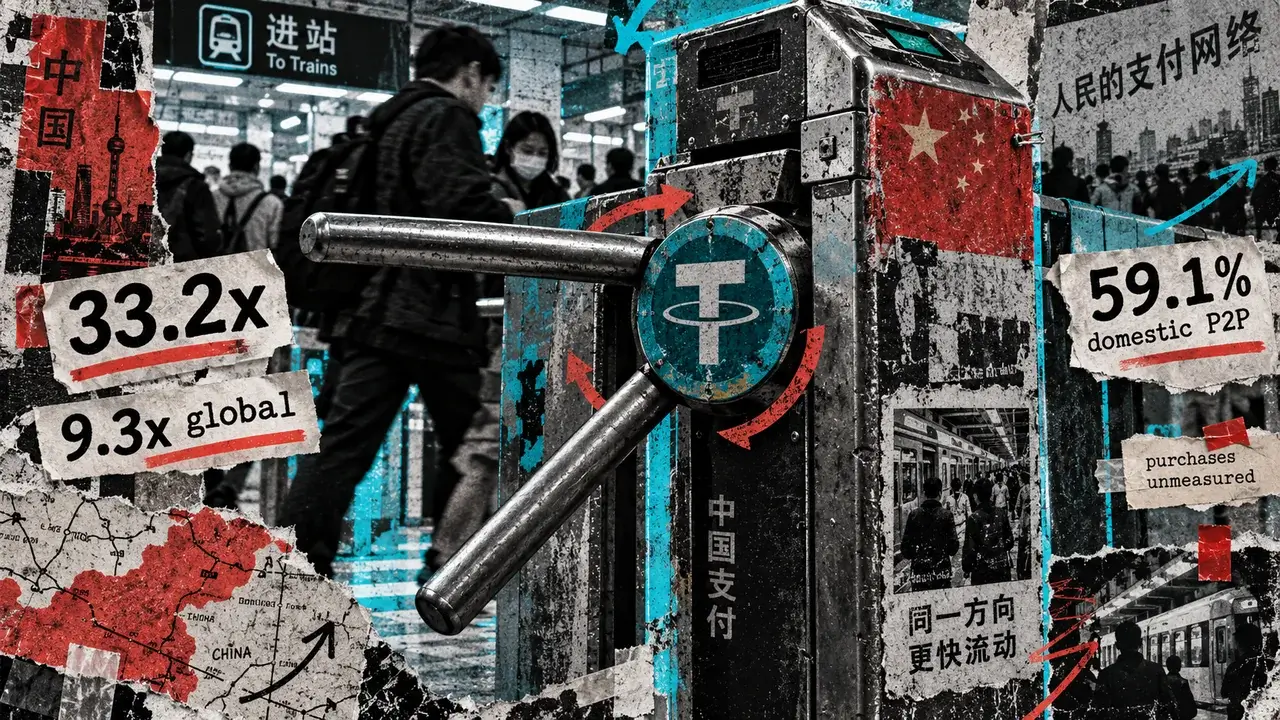
According to blockchain analytics firm Chainalysis, China generated at least $176 billion in crypto activity during the 12 months through June 2026. Of that total, 59.1% occurred through domestic peer-to-peer transfers rather than exchanges and other centralized platforms—a share 3.5 times higher than the previous period.
This pattern diverges sharply from most major crypto markets, where exchanges remain the primary entry and exit point for users.
Stablecoin Activity Accelerates
Domestic stablecoin payment activity began accelerating around March 2025 and continued expanding for 13 consecutive month-over-month periods. Monthly new activity rose from roughly $240 million in March 2025 to almost $5 billion approximately one year later.
Growth concentrated in smaller transaction sizes. Stablecoin volumes below $100 increased 996%, while transfers between $100 and $1,000 jumped 1,057%. Activity between $1,000 and $10,000 climbed 1,321%.
Chainalysis noted that the timing of this acceleration coincided with China's expansion of its social-credit system into finance and online activity in March 2025. The firm described this as a working hypothesis that users with restricted access to conventional financial services may be turning to cryptocurrency, or that others may use stablecoins to settle transactions outside monitored banking channels. However, Chainalysis cautioned that blockchain data cannot establish why individuals choose particular payment methods.
High Turnover Suggests Active Circulation
The velocity of stablecoin movement through China-attributed wallets indicates users may be treating them as transactional liquidity. Chainalysis calculated annual turnover of self-custodied stablecoin holdings in China at 33.2 times—more than triple the global benchmark of 9.3 times and significantly higher than neighboring markets.
Japan recorded turnover of 9.9 times, Hong Kong 6.1 times, South Korea 5.1 times, and Taiwan 3.5 times.
During the period, China-attributed wallets held an average of $3.1 billion in stablecoins but transferred $104.1 billion across 18.1 million transactions. This pattern indicates tokens were repeatedly returned to circulation rather than remaining dormant.
Regulatory Challenge Ahead
This decentralized structure distinguishes China from neighboring markets that depend heavily on regulated exchanges. China's restrictions on centralized platforms have pushed activity toward direct wallet transfers, potentially creating a challenge for Beijing as dollar-linked tokens circulate through decentralized networks without relying on domestic financial intermediaries.
For stablecoin issuers and crypto service providers, China represents significant potential demand but remains difficult to serve directly due to regulatory restrictions. Growth may continue through offshore platforms, over-the-counter networks, and self-custody arrangements rather than conventional consumer-facing crypto businesses.
The key question is whether this acceleration persists as Chinese authorities expand oversight of digital payments and financial activity. If smaller stablecoin transfers continue increasing alongside high wallet turnover, regulators may face a growing pool of dollar-linked value circulating beyond the exchange infrastructure that earlier crypto restrictions were designed to contain.