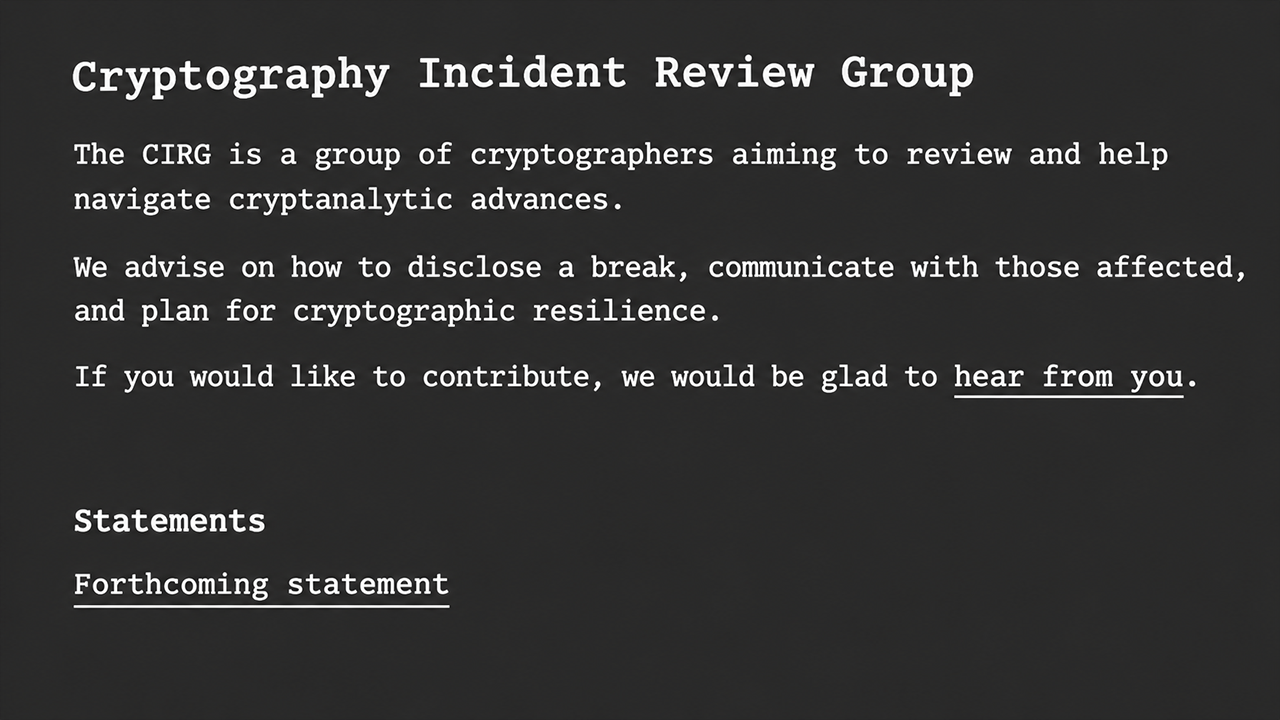
A coalition of leading cryptographers has launched the Cryptography Incident Review Group (CIRG) to evaluate possible advances in cryptanalysis, especially those rumored to stem from artificial intelligence (AI) research labs.
Group composition and purpose
The group, comprising roughly 21 experts including Dan Boneh (Stanford), Yael Tauman Kalai and Vinod Vaikuntanathan (MIT), Matthew Green (Johns Hopkins), Chris Peikert (University of Michigan) and others, operates in a personal capacity. Its website states that CIRG will review cryptanalytic advances, guide responsible disclosure, and help develop safeguards for affected technologies.
Background of the rumors
Speculation intensified after theoretical computer scientist Scott Aaronson cited unnamed AI labs as possibly possessing “bombshell” cryptographic algorithms, though he clarified that the information fell short of confirming any breakthrough. Rumors have included the idea that AI could factor large integers in polynomial time, potentially compromising RSA encryption, but no such claim has been independently verified.
Industry response
On November 28, Coinbase said it has seen no actionable evidence of a practical break affecting major blockchain signature schemes. The exchange noted that while AI‑assisted improvements to integer factoring exist, they do not threaten elliptic‑curve cryptography used by Bitcoin and other blockchains. Coinbase’s cryptography team continues to monitor research and prepare for post‑quantum transitions.
Implications for Bitcoin and other cryptocurrencies
Bitcoin’s security relies on the elliptic‑curve discrete logarithm problem and SHA‑256 hashing, which differ from the integer‑factoring problem underlying RSA. A breakthrough against RSA would not automatically invalidate Bitcoin’s signature algorithms. However, a theoretical proof that P equals NP could affect many computational problems, though practical impact would depend on the efficiency of any resulting algorithms.
Community perspective
Experts such as Blockstream CEO Adam Back and Jan3 founder Samson Mow have emphasized that even if P = NP were proven, Bitcoin could adapt by adopting alternative cryptographic primitives. The formation of CIRG reflects growing awareness that AI‑driven research may outpace traditional evaluation and disclosure processes.
Next steps
CIRG has indicated that a formal statement is forthcoming, though it has not identified a specific incident or confirmed vulnerability. As of November 29, no practical break of a major blockchain’s signature scheme has been demonstrated, and the P versus NP problem remains unsolved.