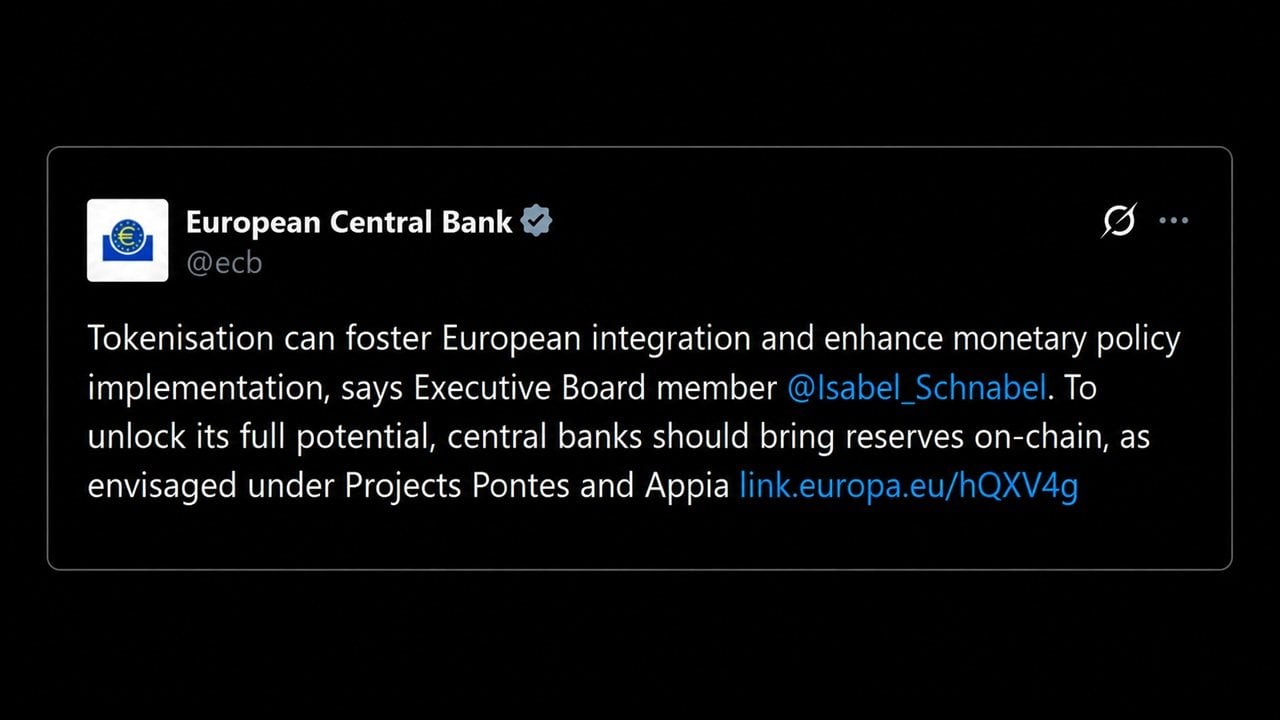
Isabel Schnabel, a member of the European Central Bank's Executive Board, told attendees at the Jackson Hole Economic Policy Symposium that central bank money must transition to blockchain-based infrastructure. Schnabel emphasized that stablecoins lack the independent capacity to expand liquidity during financial stress, a role only central banks can fulfill.
Schnabel argued that tokenization technology can make financial transactions faster, safer, and more programmable, but only if central bank money operates on the same infrastructure as other tokenized assets. The statement marks a notable shift for ECB officials, who have historically focused on regulating cryptocurrency and stablecoins rather than adopting distributed ledger technology directly.
Project Pontes: Near-Term Implementation
The ECB expects Project Pontes to launch in September 2026. The project will initially synchronize the ECB's TARGET Services—the payment infrastructure eurozone banks use to settle euro transactions—with distributed ledger platforms operated by market participants.
Over time, Pontes is designed to support settlement finality directly on a Eurosystem-operated DLT platform, with smart-contract functionality and eventual 24/7 operation.
Project Appia: Longer-Term Blueprint
Project Appia represents the ECB's long-term strategy, tasked with mapping the architecture, technical standards, and legal framework needed for a genuine European market in tokenized assets. A full blueprint is expected by 2028.
Trials testing interoperability between DLT platforms and existing settlement rails have processed approximately 1.6 billion euros across 64 participants in nine jurisdictions. European issuers have placed nearly 4 billion euros in DLT-based instruments since 2021. Since March 2026, the ECB has accepted DLT-based assets as eligible collateral for its own credit operations.