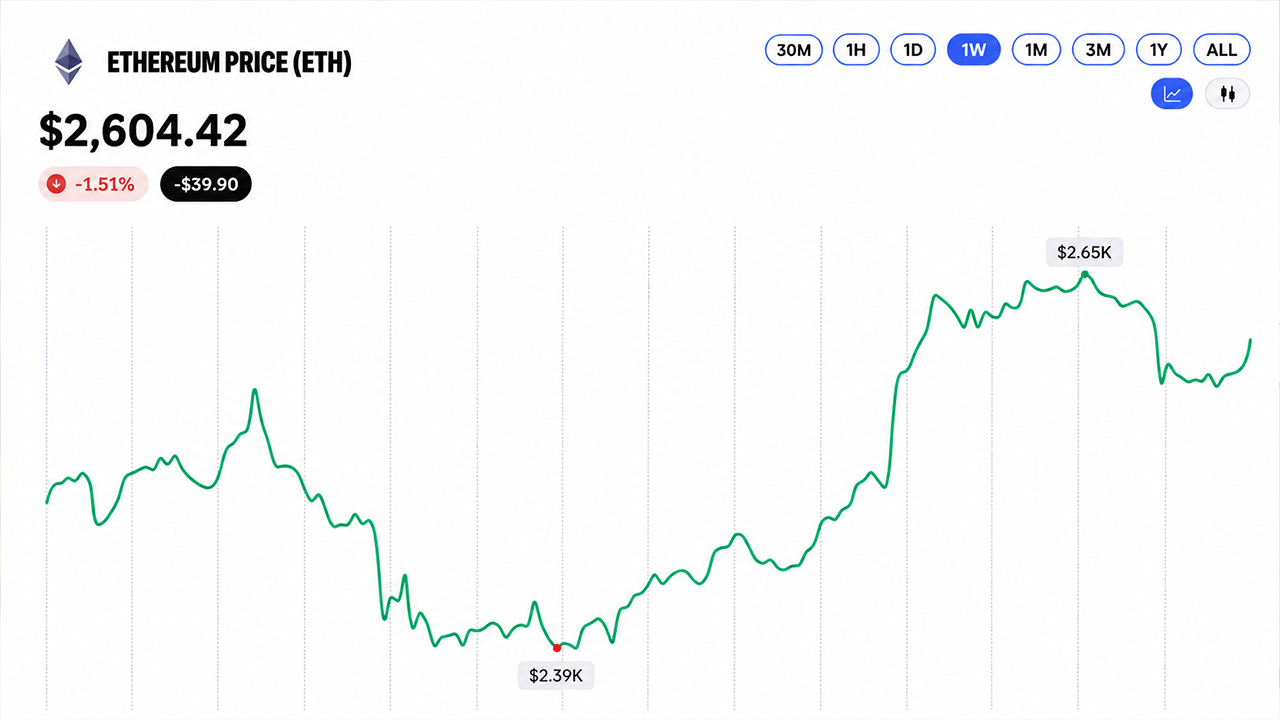
Ethereum's price has retreated to around $2,600 after briefly rallying to nearly $2,668 in recent days, following a low of $2,360.70 around mid-September. Despite reclaiming levels unseen since January, the second-largest cryptocurrency remains approximately 47% below its October 2025 peak near $4,946.
The pullback highlights a broader challenge facing Ethereum this cycle. The ETH/BTC ratio sits near 0.032, substantially below its 2021 high around 0.08, underscoring Ethereum's underperformance relative to Bitcoin. However, structural developments suggest some underlying strength: roughly 35% of Ethereum's supply is now staked, exchange balances continue falling, and spot Ethereum ETFs hold approximately $16.7 billion in assets. ETF flows have been mixed, with outflows exceeding $400 million midweek followed by approximately $144 million in inflows on September 18.
Competing Price Forecasts
Wall Street and prominent crypto figures have laid out divergent year-end and near-term targets. Fundstrat's Tom Lee outlined a bullish scenario in which Ethereum could reach $6,000 by December if Bitcoin reaches $150,000 and the ETH/BTC ratio recovers to 0.04. BitMEX founder Arthur Hayes has positioned Ethereum as his largest holding and floated a speculative $10,000 target for end-2026 based on anticipated liquidity expansion.
Standard Chartered analyst Geoff Kendrick has projected $4,000 by end-2026, while Citi has previously set a 12-month target as low as $2,240. These targets underscore significant disagreement on Ethereum's near-term direction despite analysts monitoring largely similar market conditions.
Technical Levels and Near-Term Catalysts
Ethereum is trading above major daily moving averages, including its 50-day simple moving average at $2,272.50 and 200-day simple moving average at $2,076.10. Resistance extends from $2,655 to $2,672, with a sustained break potentially opening $2,800 to $3,000. A failure to hold could bring $2,400 back into play.
The Glamsterdam upgrade presents a potential market catalyst. Sepolia is scheduled for October 6, with the Ethereum mainnet upgrade penciled in for Q4. The fork targets higher throughput, parallel execution, greater blob capacity, and changes to block construction. Success could reinvigorate interest in Ethereum's scaling narrative.
For Ethereum to reach the higher price targets discussed, multiple conditions must align: sustained ETF inflows, improved performance relative to Bitcoin, supportive macroeconomic conditions, and a clean technical breakout through resistance levels.