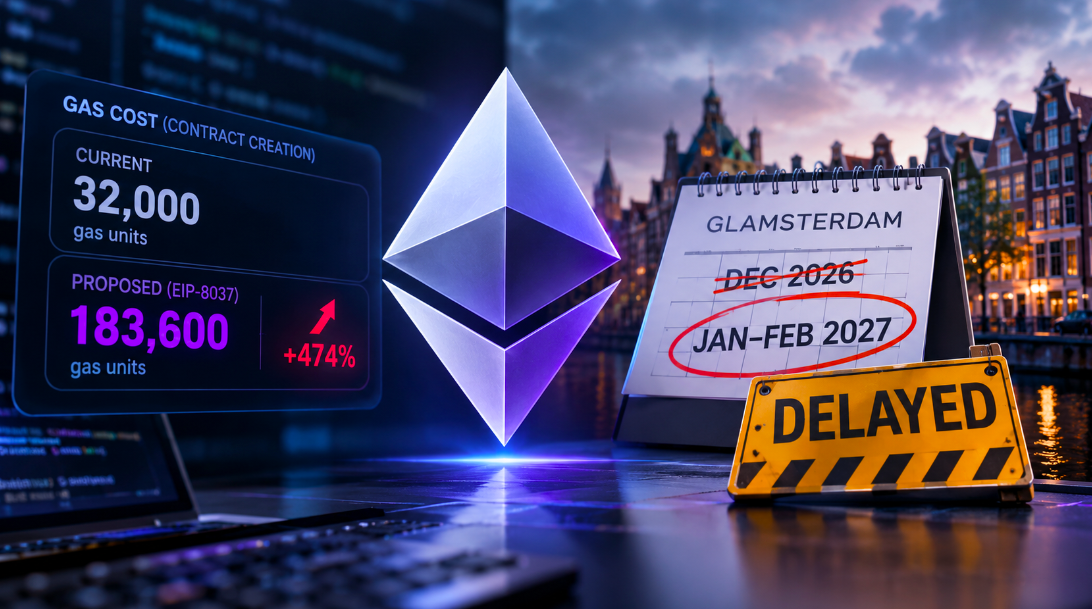
Ethereum's next major network upgrade, Glamsterdam, is facing a potential delay into 2027 as developers investigate whether proposed gas-pricing changes could disrupt thousands of existing smart contracts.
Compatibility Issues Emerge During Testing
Security researchers identified compatibility problems involving existing smart contracts during testing of the upgrade. Two proposals, EIP-8037 and EIP-8038, would significantly change how Ethereum charges for certain blockchain operations, including the cost of creating blockchain state and accessing stored information.
One notable change would increase the base gas charge associated with creating a smart contract from 32,000 to 183,600 units—an increase of approximately 474% before additional execution and code-storage costs.
Ethereum Foundation developer Marius van der Wijden has warned that as many as 15,000 programs could potentially be affected. Some deployed smart contracts rely on assumptions about gas consumption that could become invalid after the upgrade, potentially causing them to fail execution under the new rules.
Updated Timeline Under Consideration
The Glamsterdam activation originally planned for the Hoodi test network on October 26 was postponed while developers investigated the compatibility issues. Following additional audits and discussions, developers are considering a revised testing schedule.
A tentative Hoodi activation during the week of December 14 has been discussed, while the mainnet upgrade could arrive in late January or February 2027 if testing and application fixes proceed successfully. The next developer meeting, scheduled for November 26, could provide greater clarity on the revised timeline.
Strategic Importance for Ethereum's Scaling
Despite the uncertainty, Glamsterdam remains a key component of Ethereum's long-term development strategy. The upgrade is designed to increase network capacity through improvements to transaction processing, block validation, and gas accounting.
One major objective is to support a substantial increase in the network's gas limit, potentially expanding capacity from approximately 60 million to 200 million gas per block—representing more than a threefold increase in theoretical gas capacity.
Developers face a difficult balance: preserve the proposed gas changes and allow affected projects time to adapt, or revise the specifications and potentially introduce additional testing requirements.