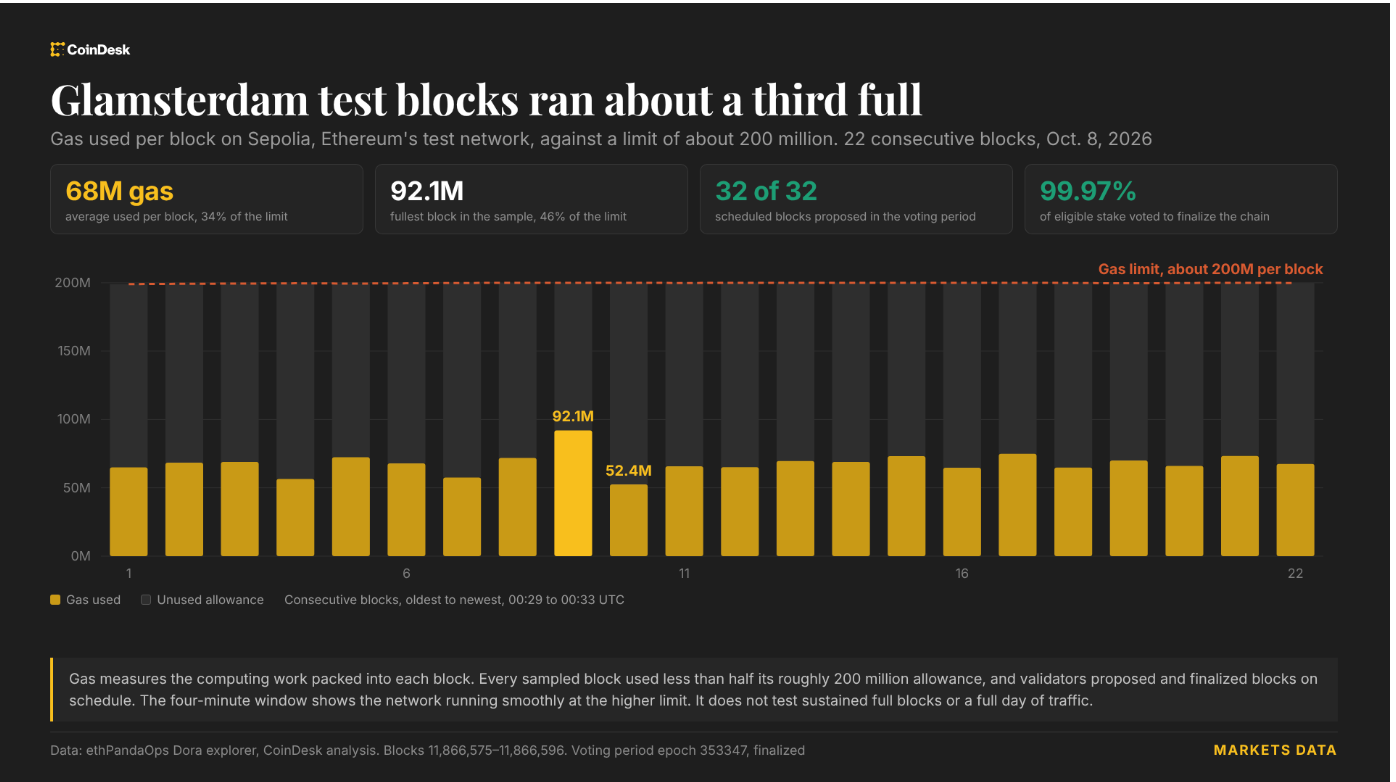
Ethereum's Glamsterdam upgrade is running on Sepolia, a public test network where developers evaluate software changes before deploying them to the main blockchain. The upgrade activated Tuesday and increased the processing budget to nearly 200 million gas per block, up from approximately 60 million previously.
Gas measures the computing work required to process transactions on Ethereum. A larger processing allowance could enable the network to accommodate more activity before transaction fees rise due to congestion.
Early testing showed blocks ran well below capacity. A review of over 25 consecutive test blocks found they used roughly 52 million to 92 million gas each, representing 26% to 46% of their available allowance. During a six-minute voting period early Thursday, all 32 scheduled blocks were proposed and 99.97% of eligible testnet stake voted toward finality.
The upgrade modifies how Ethereum's network participants divide work. It establishes new rules for the handoff between specialists assembling transactions and validators publishing blocks, giving validators more time to verify transaction calculations. Blocks now include a list of accounts and stored information their transactions touch, allowing software to fetch data in advance and process unrelated transactions simultaneously.
Glamsterdam changes gas charges for creating and accessing stored data. The threefold increase in the processing budget does not translate directly into three times as many transactions, since the upgrade also alters how much gas particular tasks consume.
The next public test network, Hoodi, is tentatively scheduled for Oct. 27 pending Sepolia results. Ethereum's mainnet has no activation date set for the upgrade.