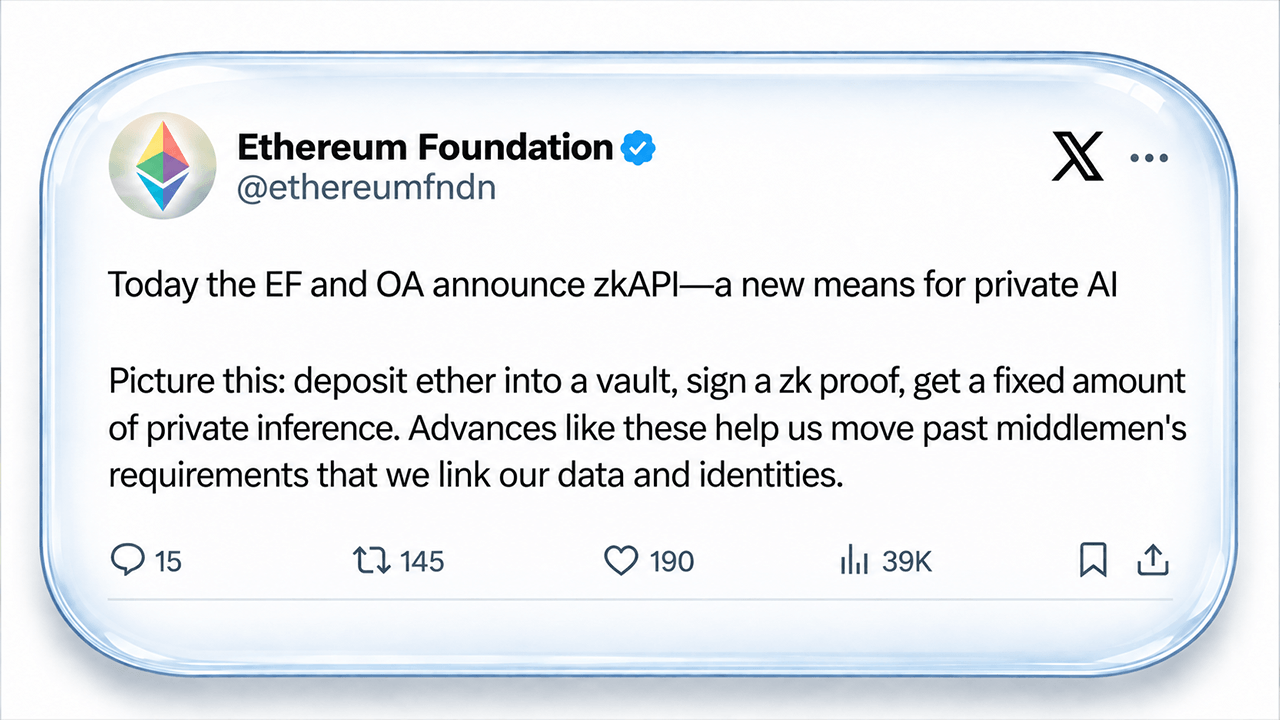
The Ethereum Foundation and Open Anonymity Project have launched zkAPI, a system designed to separate payment identity from API usage. Live on Ethereum mainnet since October 1, the protocol lets users prepay for AI and other metered services without attaching their billing identity to individual requests.
How zkAPI Works
Users deposit ETH, USDC, or other supported credits into an Ethereum vault contract. Those funds are represented by a private note that can be spent without revealing which original deposit supplied the money. The system uses zero-knowledge proofs to prove that a funded note covers the requested spending without exposing the note's identity.
After payment authorization, zkAPI's server creates a fresh, short-lived API key with a spending cap rather than giving providers a permanent key tied to a customer account. This temporary key exists only in the user's device memory before the request goes to the AI provider. When the key expires, the provider records actual consumption in a signed usage receipt, and zkAPI deducts that amount from the user's private balance.
"The server that handles money never sees content, and the provider that sees content never learns the billing identity behind a key," the Ethereum Foundation explained. The public blockchain itself sees only deposits, closes, and withdrawals, not what the balance purchased.
Privacy Limitations
zkAPI separates billing identity from API usage but does not hide what users type into AI models. AI providers still receive prompts and responses because they must run the models to function.
Additional privacy leakage is possible through network information. A stable IP address, timing patterns, or repeated behavior can help reconnect supposedly separate sessions. The Foundation acknowledged another vulnerability: "Shared prompt contents can act as fingerprints for anyone who can read the prompts." Repeated mentions of employers, family members, writing habits, or project documents can potentially reassemble fragmented user data across separate sessions.
Users seeking stronger network anonymity are directed toward Tor with fresh circuits for separate sessions. The protocol's repository labels zkAPI as experimental.
Broader Applications
While designed for AI payments, zkAPI's architecture could extend to blockchain RPC queries, image and video processing, VPN bandwidth, and machine-to-machine services where software agents pay for work without maintaining conventional customer accounts.