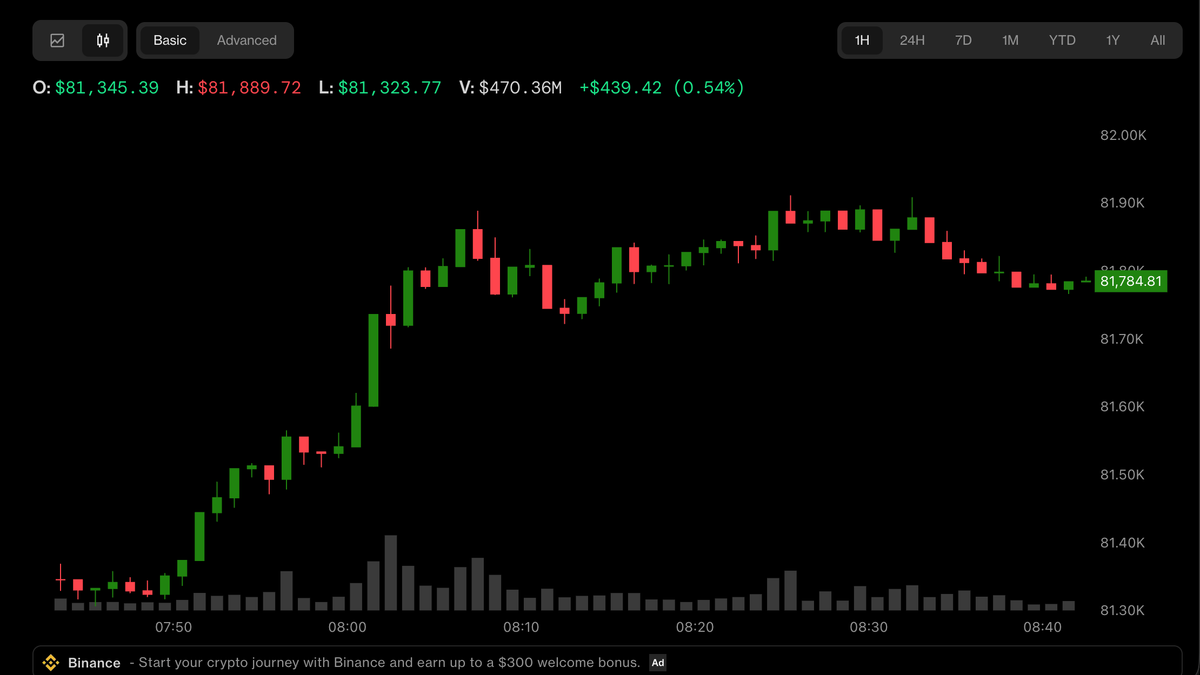
Bitcoin rallied sharply in August, gaining more than 25% in a single week while climbing approximately 30% for the month—its strongest performance since November 2024. However, Fidelity Digital Assets cautioned this week that the price recovery does not guarantee the bear market has ended.
In its fourth-quarter crypto outlook, Fidelity wrote that "despite the recent push higher in price, there is no guarantee the bear market is over." Chris Kuiper, vice president of research at Fidelity Digital Assets, presented two scenarios: bitcoin may have bottomed in July, or it could decline further to establish a new low in November or later.
Fidelity's November 2026 reference stems from bitcoin's historical pattern of forming bear-market lows at roughly four-year intervals. The previous cycle low occurred in November 2022, which would place the next one around November 2026 if the pattern repeats. The firm cautioned that "this cycle isn't guaranteed to repeat," and Kuiper noted that past cycles have not been precisely four years long, making them unreliable for market timing.
Bitcoin currently trades near $81,000 after briefly touching $82,000 late Thursday. This leaves the coin approximately 30% above the sub-$65,000 range it occupied in June and July, though still significantly below the October record of $126,080.
U.S. spot bitcoin exchange-traded funds recorded $731 million of net inflows on September 3, led by BlackRock's IBIT with $454 million. Ether ETFs added $141 million the same day.
Policy and Market Catalysts
Fidelity identified several potential catalysts beyond price action. The firm noted that stablecoin transaction volume now runs at 2.3 times that of Visa, and the real-world asset tokenization market has grown faster in 2026 than in any prior year.
On policy, Fidelity highlighted the Digital Asset Market Clarity Act awaiting Senate action and a new crypto framework proposed by the Securities and Exchange Commission. A Senate cloture vote on the clarity bill is scheduled for September 15. Kuiper said the bill could provide "greater regulatory certainty and support continued innovation in the U.S. digital asset ecosystem."
Fidelity analysts also flagged a volatility pattern, noting that bitcoin spent June through August in a low-volatility range before the sharp late-August expansion—a sequence the firm said has historically coincided with the end of bear markets.