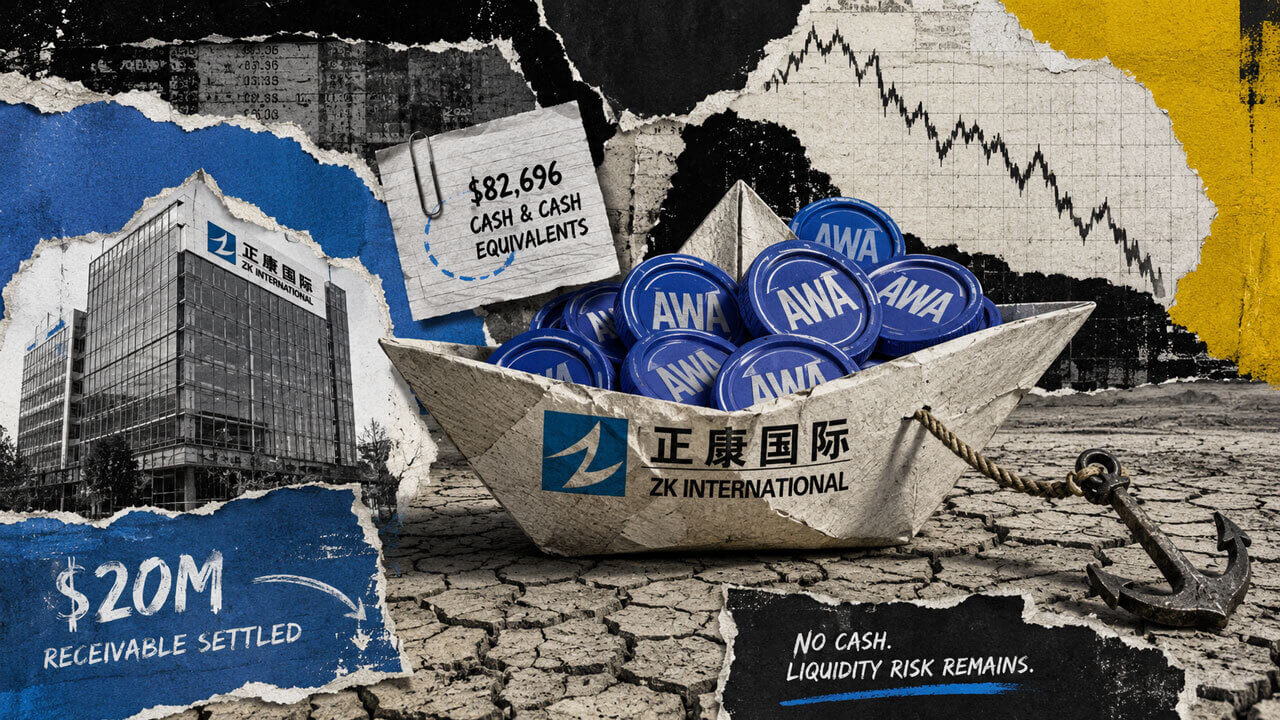
ZK International received 205,512.5 AWA tokens on July 30 to settle a $20.02 million equity-financing receivable. However, disclosures revealed that the tokens remained unmonetized and their receipt-date fair value was unresolved, leaving management's going-concern doubt in place.
At March 31, the company's continuing operations held $82,696 in cash and cash equivalents, which accounted for approximately 0.12% of its $66.44 million in total assets. The firm's continuing business centers on a pipeline-monitoring components resale operation, while AI computing services remain planned.
Three main balances accounted for $62.59 million, or 94.2%, of the company's total assets:
- A $21.57 million prepayment for AI equipment
- The $20.02 million digital-asset consideration receivable
- A $21 million receivable from the disposal of eight subsidiaries
Management noted these balances are distinct from cash or immediately available liquid resources. For the six months through March, ZK International reported a $17.02 million consolidated net loss alongside a $68.28 million accumulated deficit.
Origins of the Crypto Receivable
The crypto receivable stemmed from a February 27 private placement involving up to 40.04 million shares priced at $0.50 each. The agreement permitted payment in fiat currency or cryptocurrency at the company's discretion, and a March filing confirmed that all 40.04 million shares had been issued.
Because the AWA tokens had not yet arrived by March 31, ZK International recorded a contractual entitlement at the $20.02 million transaction price rather than holding the crypto directly. Although the July 30 delivery settled the receivable, the filing described AWA as a non-mainstream token not listed on major exchanges, noting that deposits and withdrawals were frequently suspended.
At the time of issuance, the company had not sold, transferred, or monetized any of the tokens. Furthermore, management stated it could not yet determine if the receipt-date fair value equaled, exceeded, or fell below the $20.02 million carrying amount, with any differences to be recognized in earnings once finalized.
Liquidity Outlook
The purchase agreement identified the buyers only as certain non-U.S. investors, leaving the purchaser list blank in the filed form. Management's ongoing liquidity plan relies on collecting or monetizing current assets, securing continued financing access, and managing working capital over the next 12 months. The AWA delivery successfully settled the contractual receivable, but it did not produce cash or immediately resolve the underlying valuation and liquidity risks.