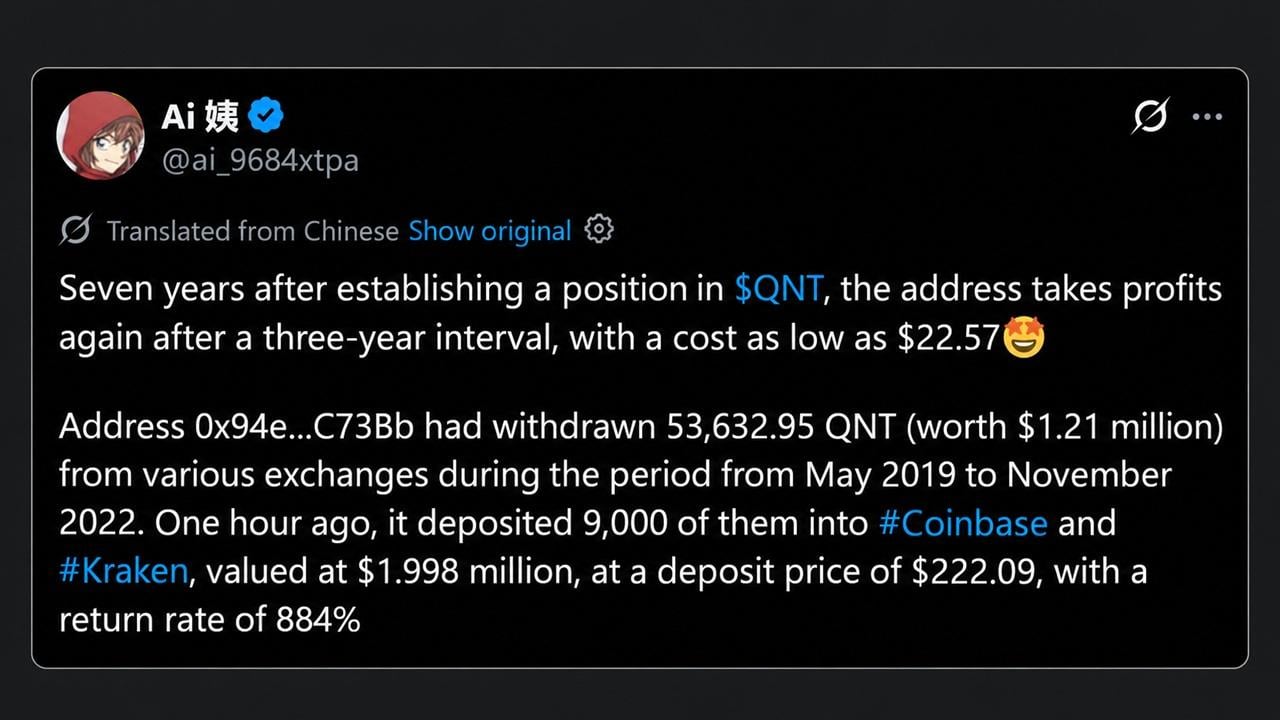
A Quant (QNT) holder who began accumulating tokens in 2019 deposited 9,000 QNT to Coinbase and Kraken on September 29, bringing in approximately $2 million at a deposit price of $222.09 per token. Based on an average cost basis of $22.57, the position realized an 884% gain.
According to onchain tracking data, the wallet had withdrawn 53,632.95 QNT from major exchanges between May 2019 and November 2022. Four linked addresses retain 25,200 QNT, valued near $6.2 million following the September 28 wallet consolidation.
Price Movement and Market Catalyst
QNT experienced a significant price surge in late September following announcements about its institutional adoption. On September 24, The Clearing House, a U.S. bank-owned payments operator, selected Quant to run the coordination layer for its On-Chain Money Initiative, a network designed for tokenized bank deposits with instant settlement capabilities.
The same day, UK Finance confirmed live tokenized sterling payments on Quant's platform with participation from Barclays, HSBC UK, Lloyds, NatWest, and Santander. QNT rose from approximately $61 on September 16 to an intraday peak of $373 on September 27, reaching within 13% of its 2021 high of $430.
Gradual Position Reduction Strategy
Onchain analysis reveals the holder has been gradually reducing its position across multiple years rather than making a single large sale. Earlier trim activities included 10,000 QNT to Bittrex in June 2019, 6,821 QNT to Binance on October 17, 2022, and 2,570 QNT to Binance on December 8, 2022.
Before depositing to exchanges on September 29, the original wallet split its remaining holdings into four new addresses on September 28. This approach of fragmenting a large position across multiple new addresses before selling is a common practice to minimize the visibility of individual order sizes.
Security Concerns Following Deposits
Within hours of the exchange deposits, address poisoning activity targeted the wallet that sent 2,000 QNT to Kraken. Between 04:41 and 05:35 UTC on September 29, zero-value QNT transfers were sent to lookalike addresses designed to mimic the legitimate Kraken deposit address, a technique used to trick users into sending funds to scam addresses during future transactions.