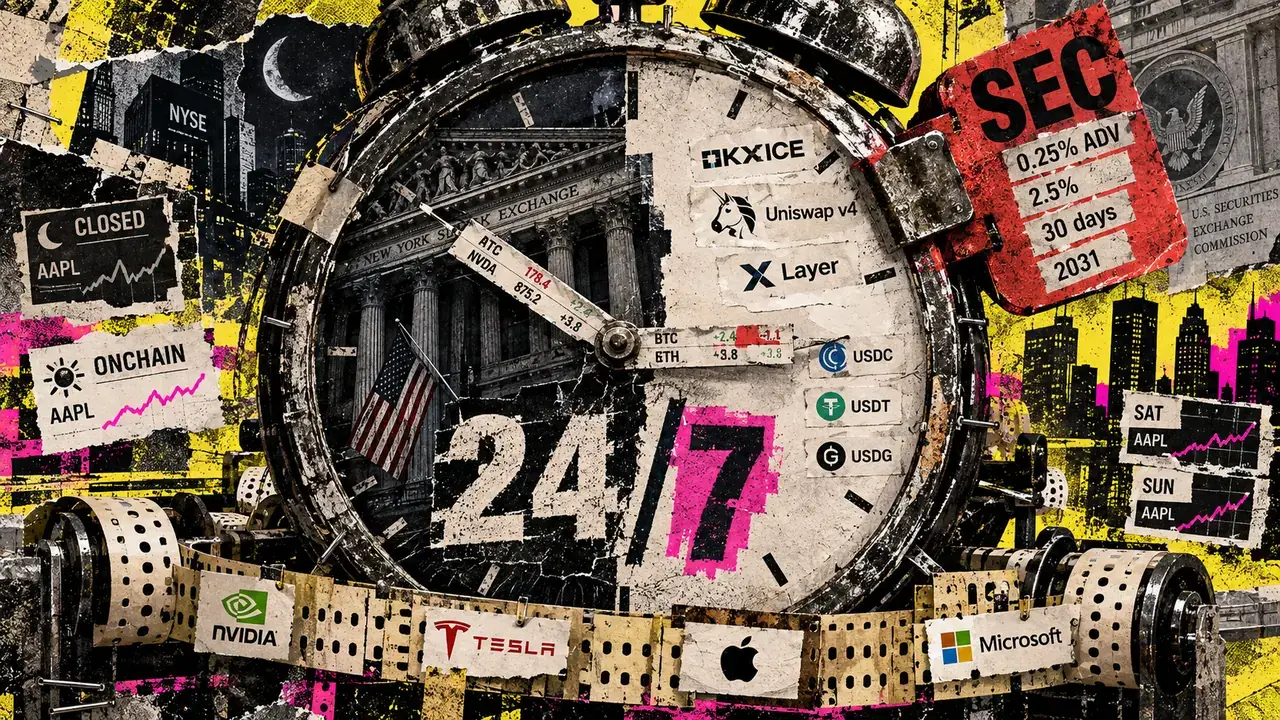
Intercontinental Exchange and OKX announced plans to launch a tokenized securities trading platform that operates continuously, allowing investors to trade tokenized versions of major US stocks around the clock. The joint venture, OKXICE, filed its notice with the Securities and Exchange Commission on October 4 under the regulator's Innovation Exemption.
The platform would initially support 63 securities, including Nvidia, Tesla, Apple, Microsoft, JPMorgan, Goldman Sachs, Coinbase, and Circle. Trading would occur on X Layer, OKX's blockchain network, using Uniswap v4 liquidity pools where tokenized stocks trade against stablecoins including USDC, USDT, and USDG.
How the Market Structure Works
Unlike traditional exchanges, prices on the OKXICE venue would be determined by the ratio of assets in automated market maker liquidity pools rather than by prevailing NYSE or Nasdaq prices. This structure allows tokenized shares to absorb market information and adjust prices during nights and weekends when underlying stocks are unavailable on traditional markets.
When market-moving news emerges outside regular trading hours, investors could continue trading tokenized shares, potentially providing reference prices for where stocks may open when traditional exchanges reopen. However, liquidity in these pools would determine how useful such signals become, as thin pools could produce larger price swings or deviations from prices investors ultimately assign to underlying shares.
Token Structure and Arbitrage
Tokenized shares must maintain equivalent economic and governance rights to underlying stocks, including dividend entitlements, voting rights, and claims on residual assets. Third-party tokenizers must maintain one underlying share for each token outstanding, with minting and redemption channels available to eligible participants during traditional trading hours.
This linkage allows arbitrage to close price gaps between onchain and conventional markets once traditional exchanges reopen. However, price dislocations during weekend or after-hours trading could occur before arbitrageurs can access the underlying cash market.
Regulatory Constraints
The SEC has imposed volume and scope limits on the experiment. Tier 1 securities are limited to 75 symbols per venue, with trading in individual stocks capped at 0.25% of the prior month's average daily volume. Any venue exceeding these thresholds must halt trading in that token for three months.
The exemption runs through September 17, 2031, though the SEC can modify it earlier. Public companies have 30 days' notice before their shares are offered and can object to being listed on the platform. Cerebras Systems has already exercised this right, preventing the venue from offering its tokenized stock under the current framework.
OKXICE cannot launch before early November, as the SEC requires 30 calendar days' notice before a venue opens. The coming weeks will test which proposed listings face issuer objections and whether sufficient liquidity providers are prepared to make prices during hours when traditional markets are closed.