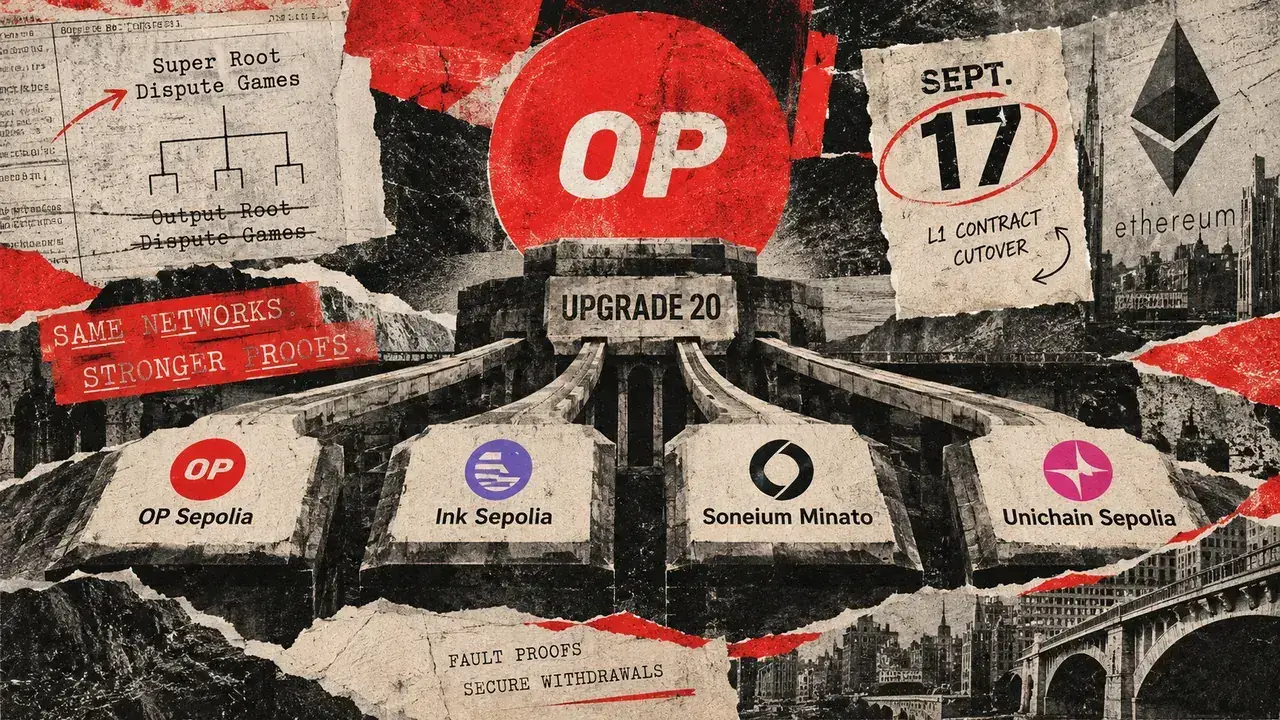
Optimism approved Upgrade 20 on September 16, advancing its fault-proof system architecture toward the requirements for future Superchain interoperability. The upgrade moves four OP Stack testnets—OP Sepolia, Ink Sepolia, Soneium Minato, and Unichain Sepolia—onto Super Root Dispute Games with a targeted contract upgrade on September 17. Mainnet execution is scheduled for September 24, conditional on the new system completing a healthy seven-day testnet soak.
The upgrade transitions the fault-proof mechanism from Output Root Dispute Games to Super Root Dispute Games, altering how OP Stack chains challenge incorrect state before withdrawals are finalized to Ethereum. Optimism describes this change as a prerequisite for interoperability, as Super Roots can eventually represent multiple chains at the same timestamp.
Technical Changes and Migration Requirements
Super Root games use timestamps to identify state rather than L2 block numbers, creating the common time reference that a multi-chain dispute system will require. Permissioned chains move to game type 5, while permissionless fault-proof deployments use game type 9.
Chain operators must update their fault-proof infrastructure, with op-challenger and op-dispute-mon requiring Super Root support before the switch. The op-proposer must move to the new RPC and game type when upgraded contracts are executed.
Bridge and withdrawal developers face related changes: applications that inspect dispute games directly can no longer assume a game's root claim is a single-chain Output Root. Integrations must recognize the new game types and retrieve chain-specific roots from the Super Root structure.
Applications using viem/op-stack for withdrawal proving need version 2.51.0 or later and must pass the initiating transaction's L2 timestamp through the proving flow. Ordinary users do not need to take action, as previously submitted withdrawal proofs remain valid and OptimismPortal continues to accept both dispute-game formats.
Implementation Timeline
The upgrade also bundles changes to Optimism's contracts manager and SystemConfig, including safeguards around upgrade sequencing and cleanup of legacy configuration functions following issues identified during Upgrade 19.
The transition changes critical security infrastructure without requiring an L2 hardfork. OP nodes that follow the chain do not require new activation configuration, while operators involved in fault proofs and withdrawals carry most of the migration work.
Interoperability across multiple chains remains a later step. Upgrade 20 keeps each chain's dispute infrastructure separate, and each new game still contains the Output Root of a single chain. By making the dispute-system transition now, Optimism aims to avoid modifying that security layer again when it activates cross-chain interoperability.