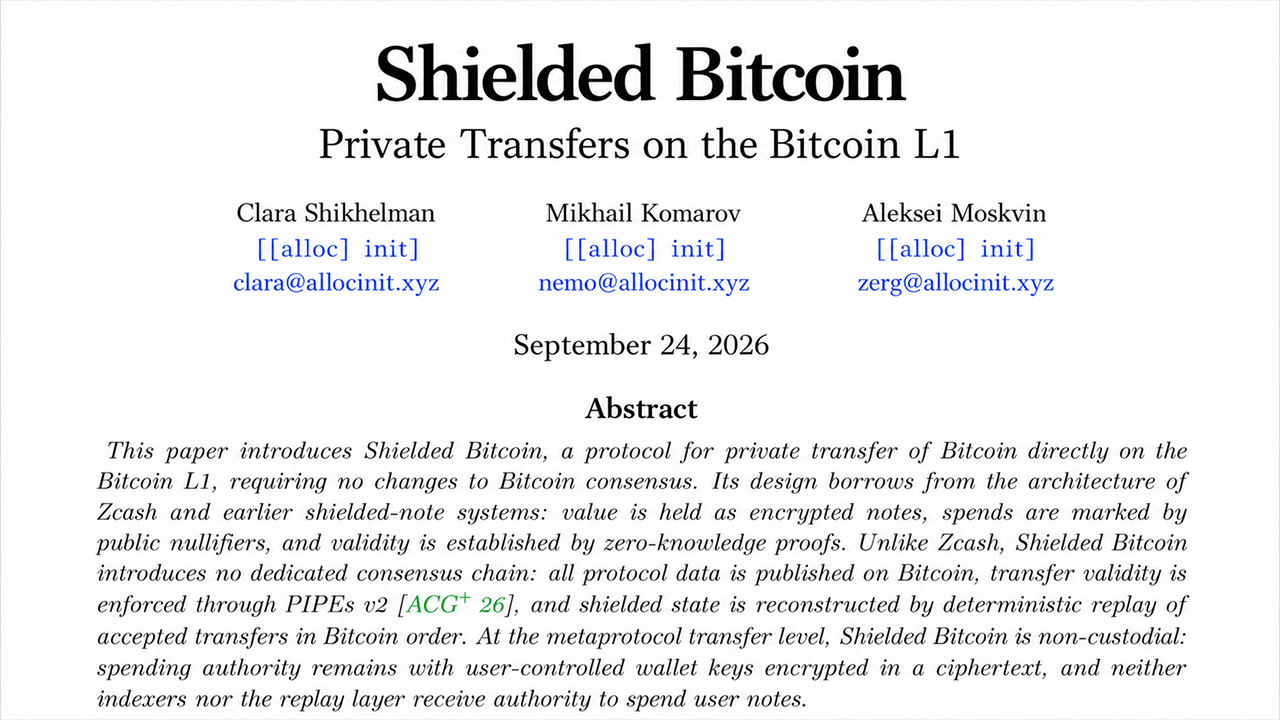
Researchers at the New York cryptography lab [[alloc] init] have proposed Shielded Bitcoin, a method to add privacy to Bitcoin transactions without modifying Bitcoin's underlying rules. The proposal, published on September 24, would allow users to hide transaction amounts and counterparties by storing encrypted data on the Bitcoin blockchain that the network itself cannot interpret.
Shielded Bitcoin operates as a metaprotocol layered on top of Bitcoin's existing infrastructure. The system uses encrypted records called notes and zero-knowledge proofs to conceal transaction details. Bitcoin acts as a public record keeper, storing and ordering encrypted messages in chronological order without understanding their content. Independent software programs called indexers verify the cryptographic proofs and reconstruct the private transaction history.
How the System Works
When a user initiates a private transfer, they create an encrypted note containing an amount and the recipient's information. The transaction publishes this encrypted note alongside a nullifier—a serial number that prevents the same note from being spent twice—and a zero-knowledge proof that validates the transaction without revealing specifics.
Observers can see that a shielded transfer occurred, including its timing, the number of notes involved, and the transaction fee. What remains hidden are the transaction amount, the sender and recipient identities, and the connection to previously spent notes.
Tradeoffs and Challenges
The proposal comes with significant constraints. Shielded Bitcoin transactions consume approximately 700 vbytes of block space compared to 100 to 200 vbytes for typical Bitcoin payments, making them roughly four times larger. Additionally, the researchers have not yet completed the mechanism for moving bitcoin into and out of the private system, which will be detailed in a forthcoming companion white paper.
The incomplete bridge between regular Bitcoin and the shielded layer represents the system's primary limitation. The planned entry and exit mechanism would use witness encryption, described as experimental technology. According to the research team, reducing witness encryption ciphertexts from approximately 300 terabytes to 8 terabytes in one year demonstrates progress, though the technology remains early-stage.
Community Response
The Zcash-influenced design has drawn commentary from the cryptocurrency community. Cypherpunk Holdings acknowledged Shielded Bitcoin as a positive development while noting that Zcash already offers a mature alternative with nearly 10 years of operation and a shielded pool exceeding $7 billion in value. Others in the community emphasized that Bitcoin's core strength lies in its decentralization and security rather than individual feature competition.
The white paper was authored by Clara Shikhelman, Mikhail Komarov, and Aleksei Moskvin. Shikhelman presented the research at BitDevs NYC on September 24 as the lab sought community feedback before publishing details on the entry and exit mechanism.