Bitcoin researchers have proposed a system for concealing transaction amounts, senders, recipients, and links between transfers directly on the network without requiring modifications to its consensus rules.
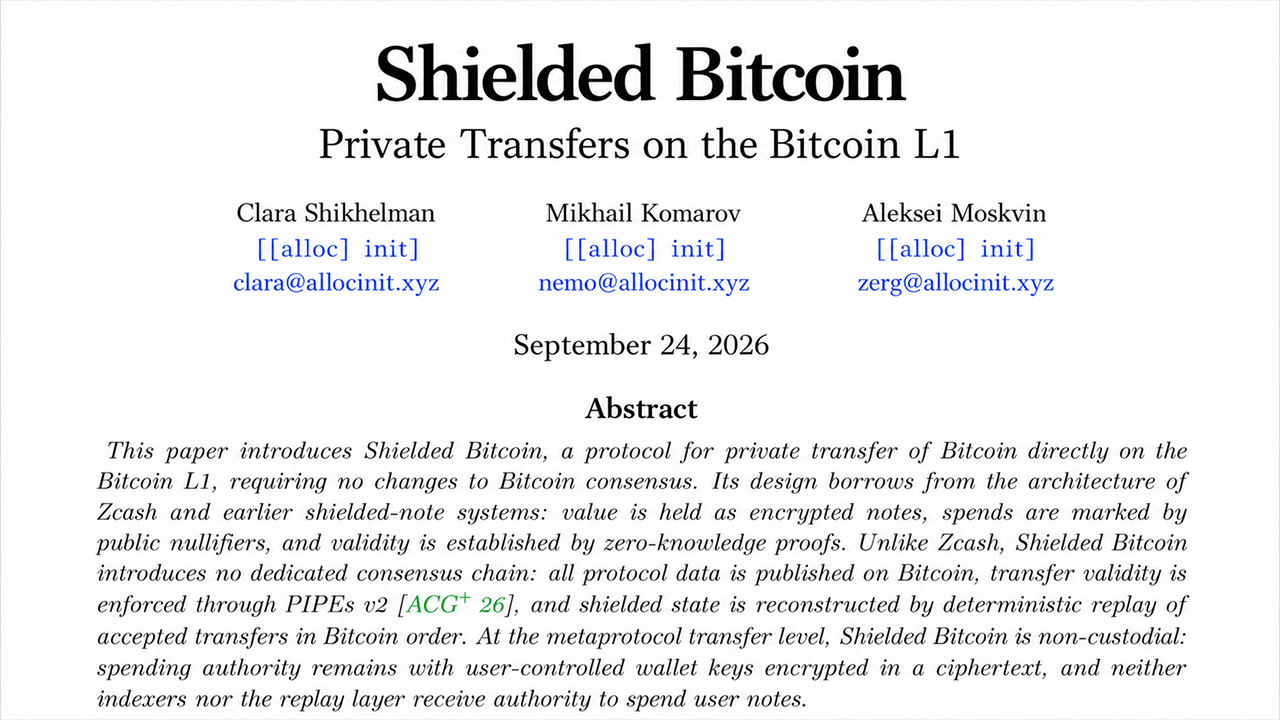
A September 24 paper from researchers Clara Shikhelman, Mikhail Komarov, and Aleksei Moskvin introduces Shielded Bitcoin, a metaprotocol designed to hide transaction details while publishing its protocol data through the Bitcoin mainnet. The design adapts privacy techniques pioneered by Zcash, including encrypted notes, public nullifiers, and zero-knowledge proofs, but does not introduce a separate blockchain.
How Shielded Bitcoin Would Work
Users would hold BTC-denominated value as encrypted notes. When funds are transferred, the sender would publish an envelope containing encrypted outputs, public nullifiers marking previously held notes as spent, and a zero-knowledge proof establishing ownership and value conservation. Bitcoin miners and nodes would not validate the shielded state themselves. Instead, implementations following the Shielded Bitcoin rules would scan blocks and replay accepted transfer envelopes in their recorded order, producing a common note tree and spent-note set.
The system would use Bitcoin's timestamped transaction history and ordering to reconstruct the privacy layer, with the metaprotocol handling encrypted balances and transfer verification. The current implementation profile uses OP_RETURN to publish encrypted transfer data, though other publication methods remain possible.
This architecture differs from Zcash, where the network's consensus rules enforce shielded transaction validity directly. Shielded Bitcoin would keep BTC consensus untouched while deriving separate private state from data anchored to the chain.
Privacy Limitations and Outstanding Questions
Some metadata would remain visible, including transaction timing, fees, input and output counts, and characteristics of the Bitcoin transaction carrying the encrypted data. The researchers have included viewing capabilities that could allow users to selectively disclose transaction information for auditing or compliance purposes.
A critical gap remains in the design: mechanisms for moving ordinary BTC into and out of the shielded system. The researchers expect peg-in and peg-out flows to rely on related work, but detailed construction has not yet been published. This leaves open questions about whether entry and exit can be made trustless and resistant to transaction linkage.
Implications for Privacy Coins
The proposal comes as privacy-focused cryptocurrencies attract renewed investor attention. André Dragosch, Bitwise Europe Head of Research, described Shielded Bitcoin as a potential headwind for privacy coins, reflecting the risk that features once associated with separate networks could increasingly be reproduced around Bitcoin without altering its monetary rules.
Zcash has recently experienced increased activity in shielded transactions, with weekly shielded transactions reaching 62,379 and nearly 5 million ZEC held in shielded pools. The network settled more than $23 billion in transfer volume in its strongest weekly total since 2021.
If Shielded Bitcoin eventually works as designed, users seeking stronger privacy would have another route besides moving into a dedicated privacy coin, potentially shifting the competitive landscape for privacy-focused networks.