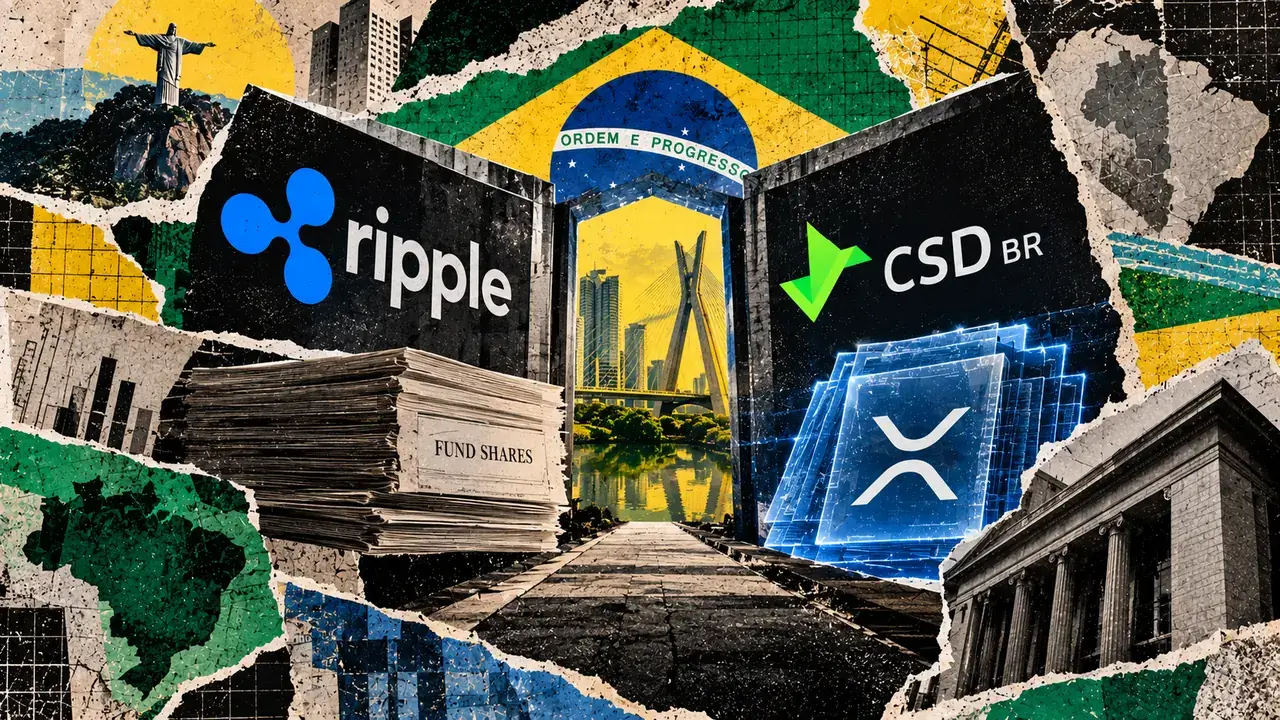
Ripple has quietly deepened its presence in Brazil's financial system, establishing the country as a focal point for its XRP Ledger (XRPL) tokenization strategy. The expansion spans cross-border payments, stablecoin distribution, and securities infrastructure—marking Brazil as home to roughly 40% of the reported $6.7 billion in tokenized real-world assets on XRPL.
According to RippleX executive Markus Infanger, approximately $2.7 billion of XRPL's total tokenized asset value is now located in Brazil. This concentration reflects the company's systematic build-out of relationships across multiple segments of the country's financial sector.
Securities Partnership Marks New Milestone
On September 29, Ripple announced a partnership with CSD BR, a regulated financial market infrastructure operator, to pilot securities tokenization. The initial phase will mirror ownership records for BTG Pactual investment fund shares on XRPL, using Ripple custody solutions. CSD BR will maintain the official registration and settlement records, with access restricted to authorized Brazilian corporate and banking participants subject to identity and anti-money-laundering checks.
Native issuance and trading are planned for future phases after validation of the mirroring system. The arrangement allows Ripple to integrate into existing financial processes without replacing traditional securities registers.
Years of Institutional Expansion
Ripple's Brazilian operations predate recent adoption rankings by years. The company opened its São Paulo office in 2019 and launched XRP-enabled payments with Travelex Bank in August 2022.
By March 2026, Ripple had expanded its institutional offering to include payments, custody, prime brokerage, and treasury management services. Payment relationships include Banco Genial, Braza Bank, and Nomad, while cryptocurrency platforms Mercado Bitcoin, Foxbit, and Ripio listed or supported its dollar stablecoin, RLUSD.
A significant development came in July 2025 when Mercado Bitcoin announced plans to tokenize more than $200 million in permissioned real-world assets on XRPL, adding securities exposure to its existing payments and stablecoin operations.
Brazil's Crypto Adoption Leadership
Brazil ranked first in Chainalysis's 2026 global cryptocurrency adoption index, placing second for cross-border flows and third for both service flows and domestic peer-to-peer activity. The ranking reflects performance across four weighted measures of adoption breadth rather than raw transaction volume.
Chainalysis estimated $252.5 billion in Brazilian crypto activity between July 1, 2025, and June 30, 2026. The country's crypto economy contracted 1.6% during that period, indicating adoption leadership coexisted with a market slowdown.
Brazilian companies primarily use stablecoins for liquidity management and cross-border transfers, purposes that align with Ripple's institutional focus.
Regulatory Environment and Future Growth
Brazil implemented restrictions on October 1 barring virtual assets from settling aggregated eFX flows between providers and foreign counterparties, though individual international virtual-asset transfers remain permitted. Ripple has announced plans to seek a Brazilian virtual asset service provider license.
While Ripple's announcements document relationships across payments, stablecoins, custody, and investment records, the company has not disclosed comparable metrics for Brazil-specific payment volume, RLUSD circulation, or active institutional usage. Sustained transaction growth and broader adoption of the CSD BR system will ultimately indicate how extensively these connections develop beyond reported asset values.