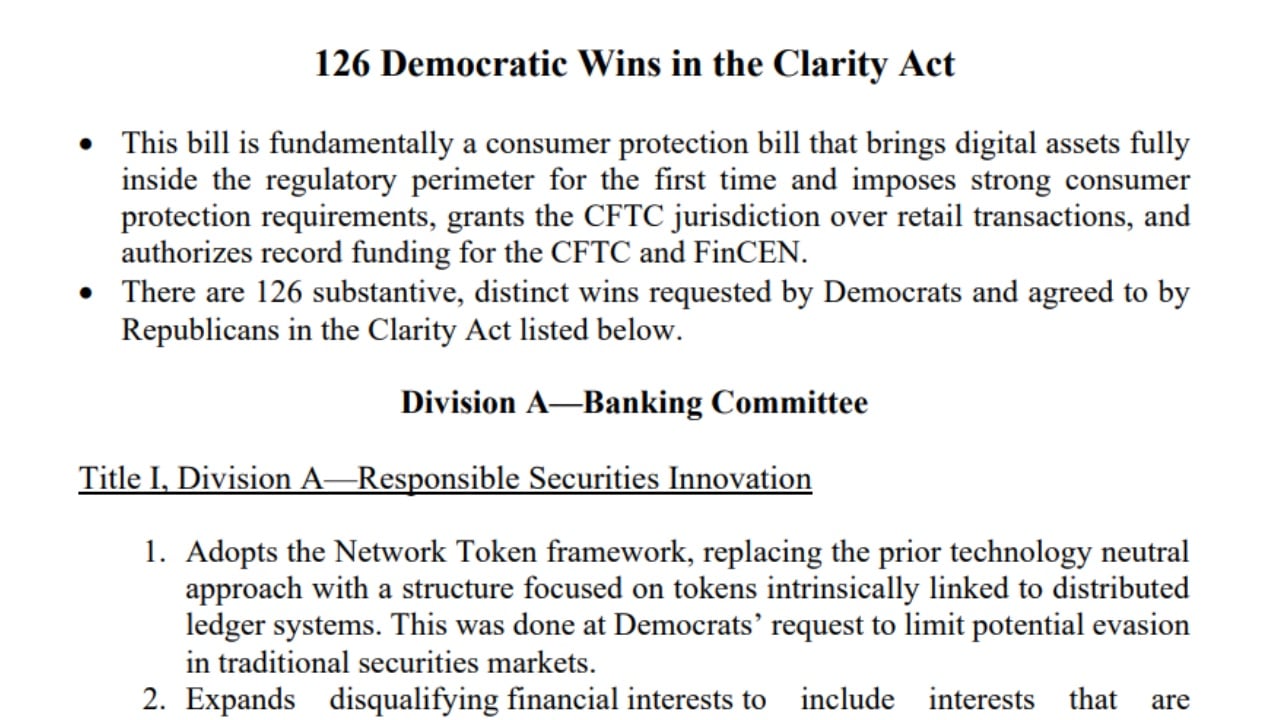
Senate Republicans released a final CLARITY Act draft on September 14 containing 126 policy revisions they said Democrats requested during negotiations. The changes modify how federal agencies would classify and oversee digital assets and establish new obligations for token issuers, exchanges, banks, developers, and government officials.
The measure was led by Senate Banking Digital Assets Subcommittee Chair Cynthia Lummis of Wyoming, Senate Agriculture Committee Chairman John Boozman of Arkansas, and Senate Banking Committee Chairman Tim Scott of South Carolina.
Token Issuers and Fundraising
For token issuers, the revisions replace a technology-neutral approach with a Network Token framework focused on tokens tied to distributed ledger systems. Issuers seeking public resale would first certify to the Securities and Exchange Commission that their assets qualify as ancillary assets rather than securities.
The proposed Regulation Crypto fundraising limit falls from $75 million to $50 million annually, with a new $200 million lifetime ceiling. Issuers raising more than $25 million would need audited financial statements. The changes also expand anti-evasion and disclosure requirements and mandate delisting after specified disclosure violations.
Certain felony convictions involving financial crime, cybercrime, money laundering, or terrorist financing would disqualify applicants for 10 years.
Illicit Finance and Banking Protections
The revisions would classify digital asset intermediaries as financial institutions under the Bank Secrecy Act and establish risk-based compliance examinations. They add federal protections for cryptocurrency ATM users and require protocols that do not qualify as decentralized to follow securities and anti-money laundering rules.
Treasury would receive authority intended to prevent deposit flight tied to payment stablecoins.
Exchange and CFTC Oversight
Exchange provisions add stricter rules for affiliate trading, conflicts of interest, best execution, customer disclosures, and custody of customer funds. Platforms would need systems for accessing private keys and periodically testing access and transfer capabilities and would submit certified annual financial statements.
The revisions broaden the proposed definition of a digital commodity to include meme coins, network tokens, and ancillary assets. They would allow the Commodity Futures Trading Commission to regulate nonfungible token trading when conducted similarly to digital commodity transactions.
CFTC provisions would authorize $150 million in appropriations and establish a volume-based fee structure. Other additions include large-trader reporting, whistleblower protections, and a new Office of the Retail Commodity Advocate.
Developer Safeguards and Ethics
Changes to the Blockchain Regulatory Certainty Act would establish a civil safe harbor for developers without displacing derivatives regulation or existing CFTC authority.
The ethics division would restrict federally elected officials, senior executive branch officials and employees, and federal judges from issuing or sponsoring digital assets or holding significant financial interests in issuers. The ethics provisions would take effect one year after enactment and would be enforced by the Justice Department and state attorneys general.
Senate Vote Scheduled
A cloture motion on proceeding to the measure is scheduled for September 15. Cloture generally requires 60 votes. If cloture is invoked, the final legislative text would be offered as a substitute amendment, opening Senate debate rather than approving the bill.
The vote follows the Senate Banking Committee's 15-9 bipartisan vote to advance the measure in May. A bipartisan coalition of 18 state attorneys general opposed the CLARITY Act on September 14, arguing that preemption language could weaken state authority over cryptocurrency fraud, registration, and investor protection.