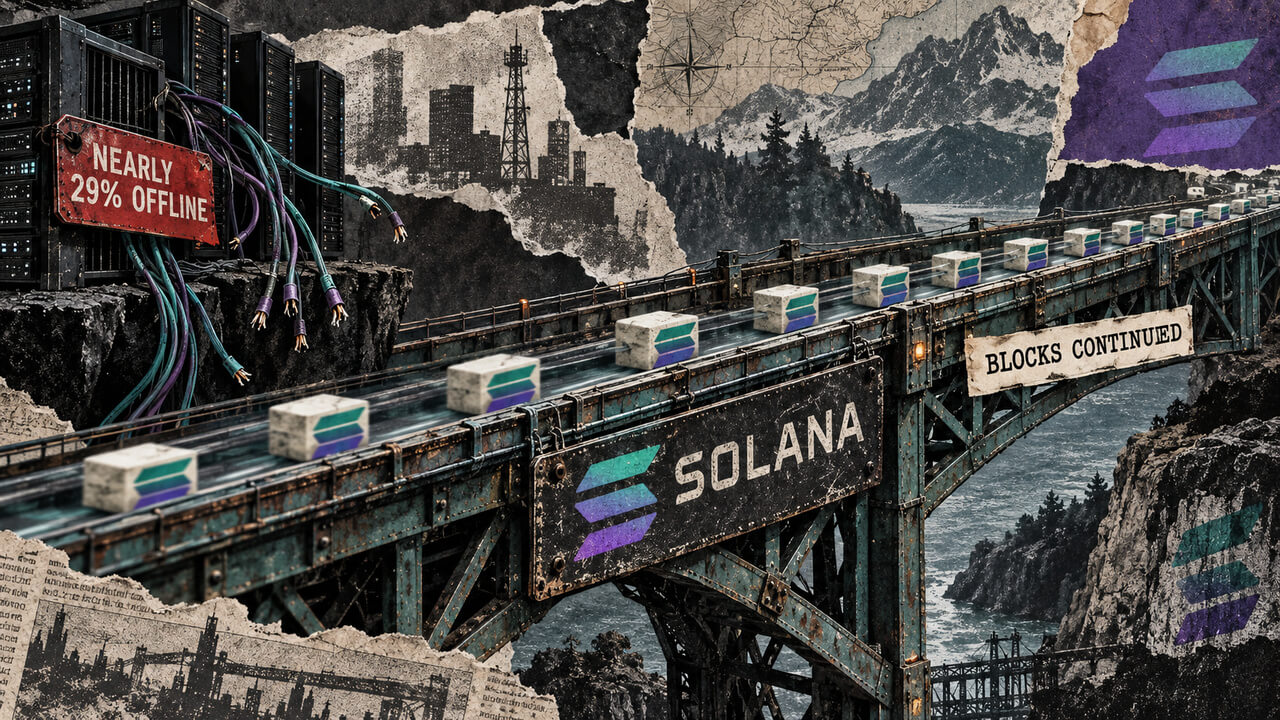
A routing failure at Teraswitch, Solana's largest infrastructure provider, disrupted network operations on August 12 by taking validators representing nearly 29% of network stake offline, according to a Solana Foundation account published September 14.
The outage originated from a stale default route on a Miami edge router. Routine transit-provider maintenance activated the problematic route, while transposed values in a routing policy applied a "no-export" instruction toward Europe and Asia-Pacific. The bad route spread across Teraswitch's network, preventing affected data centers from reaching the internet through healthy local routers. Twelve sites across Europe and Asia-Pacific lost internet and inter-site connectivity, including infrastructure hosting Solana validator and RPC nodes.
Despite the scale of the disruption, the Solana network continued producing blocks. However, performance deteriorated significantly during the outage. Independent monitoring firm Metrika recorded skipped slots rising above 32%, non-vote transaction throughput dropping below 300 per second from a typical range of approximately 1,100 to 1,300, and about half an hour during which newly produced blocks had not yet reached finality.
Solana requires more than 66% of stake voting to maintain consensus finality. The roughly 29% of stake that went offline stayed approximately 4% to 5% below the 33% finality-halt threshold, meaning the network avoided a chain-wide production halt.
Teraswitch deployed provider-side hardening the same day to prevent an invalid route from stopping sites from using healthy local edge routers. The company's postmortem indicated that additional route monitoring remained in progress, with infrastructure diversity and observability identified as continuing resilience tests.