Two governance proposals on the Solana network could sharply reduce token issuance and increase token burns, cutting staking yields roughly in half over the next three years. The changes present a trade-off between lower passive income for stakers and a tighter long-term supply profile for SOL.
Proposals Driving the Monetary Shift
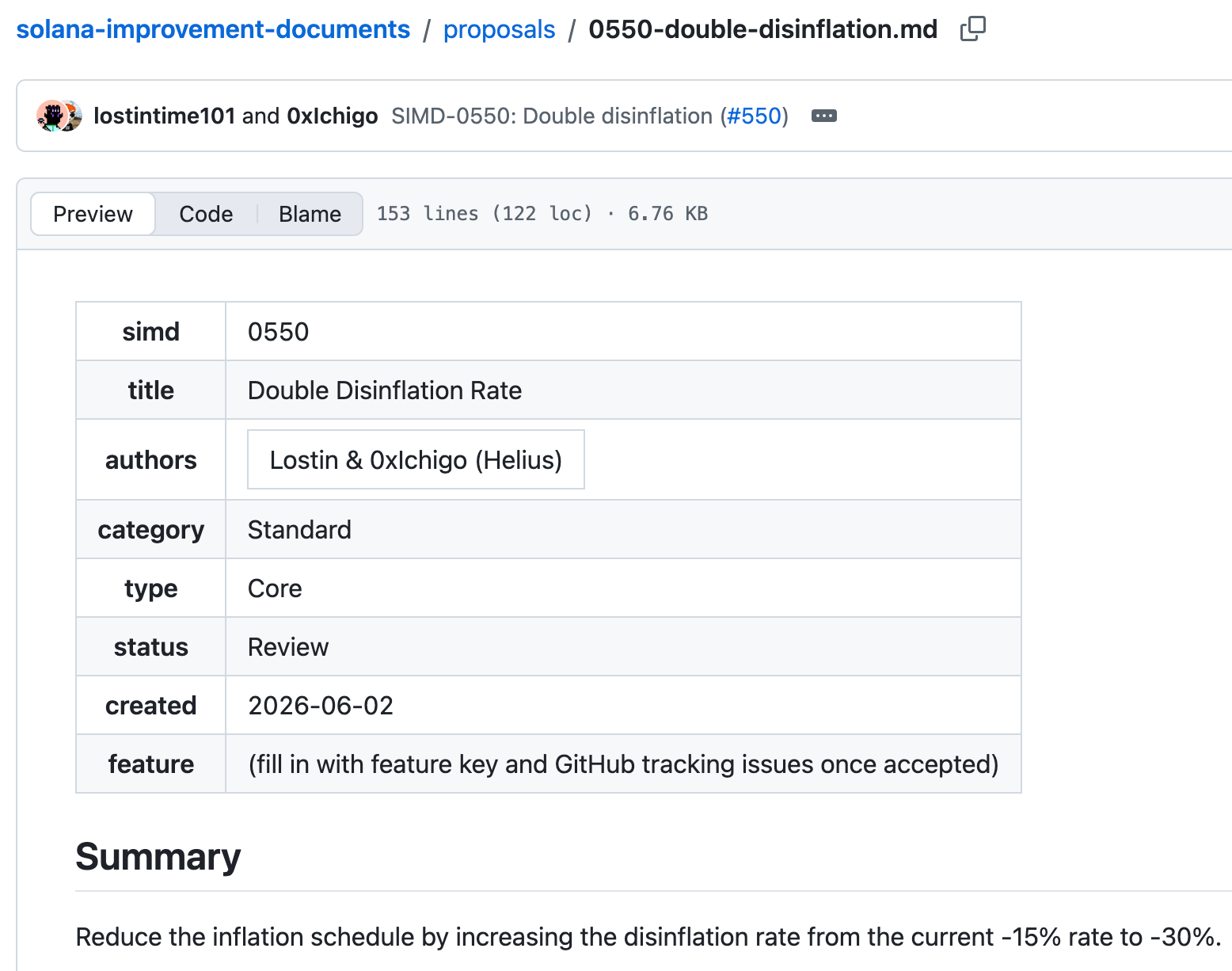
The shift is being driven by two main proposals. SIMD-550, proposed by Helius, aims to double Solana's annual disinflation rate from 15% to 30%. Major validators including Forward Industries and Blueshift have voted in support of SIMD-550, while Everstake and P2P.org have voted against it.
The second proposal, SIMD-553, was submitted by Temporal and approved in July. It introduces additional token burns tied to requested compute units. According to Matt Mena, senior crypto research strategist at 21Shares, the combination of SIMD-550 and SIMD-553 could reduce SOL emissions by an estimated $1.4 billion to $1.5 billion over six years.
Impact on Staking Yields and Validator Economics
Solana staking currently yields approximately 5.25%, with protocol inflation making up the largest component alongside transaction fees and MEV revenue. Under SIMD-550, Solana would reach its 1.5% terminal inflation rate around the first half of 2029, rather than around 2032.
Projected nominal staking yields would decline to about 4.34% in year one, 3% in year two, and 2.25% in year three. Meanwhile, SIMD-553 would increase daily SOL destruction from roughly 600 to 800 SOL up to between 7,500 and 9,000 SOL at current activity levels.
Validator economics are also a concern under the new projections. With voting costs potentially rising and inflation rewards dropping, estimates indicate that two validators could become unprofitable in year one, with that number rising to about 30 by year three.
Potential Effects on Solana DeFi
Currently, about 67.9% of SOL is staked, which is nearly double Ethereum's staking rate of 34.1%. Analysts note that lower passive returns could encourage holders to shift capital out of staking and into decentralized finance (DeFi) applications such as lending and trading, provided that network usage and transaction fees grow enough to offset the falling inflation rewards.