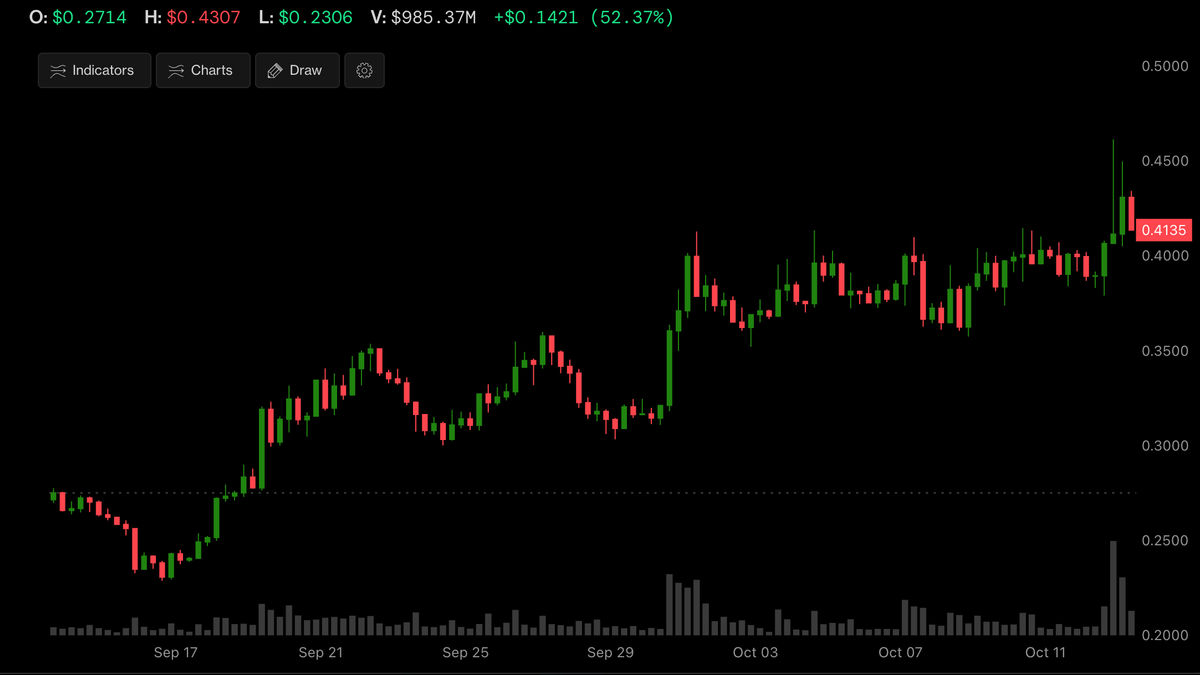
STX, the native token of the Bitcoin layer-2 project Stacks, has surged nearly 10% in 24 hours, 14% over the past week, and more than 50% in four weeks, outperforming bitcoin, ether, XRP, and other major cryptocurrencies.
The token's outperformance reflects investor interest in Stacks' non-custodial bitcoin staking architecture. This framework allows BTC holders to stake and earn yield directly on the main Bitcoin blockchain while maintaining strict control of their private keys—a contrast to traditional approaches that require users to wrap assets into synthetic tokens or use cross-chain bridges.
Stacks' architecture relies on a mechanism called bonding, which requires participants to lock up assets to secure the network. The upcoming Bonding Period 3, scheduled for November, requires holders of native STX to lock a specific ratio of STX alongside their BTC, equivalent to roughly 5% of the total value of their BTC, to secure protocol stacking capacity.
This structure creates a feedback loop for STX: as more BTC moves into the Stacks ecosystem, a larger portion of STX becomes systematically locked and removed from active circulation. By tying bitcoin liquidity directly to STX scarcity, the architecture affects demand-supply dynamics in the token's favor.
Bonding Period 3 follows Periods 1 and 2, which served as preparatory phases to transition signers and bootstrap initial liquidity.