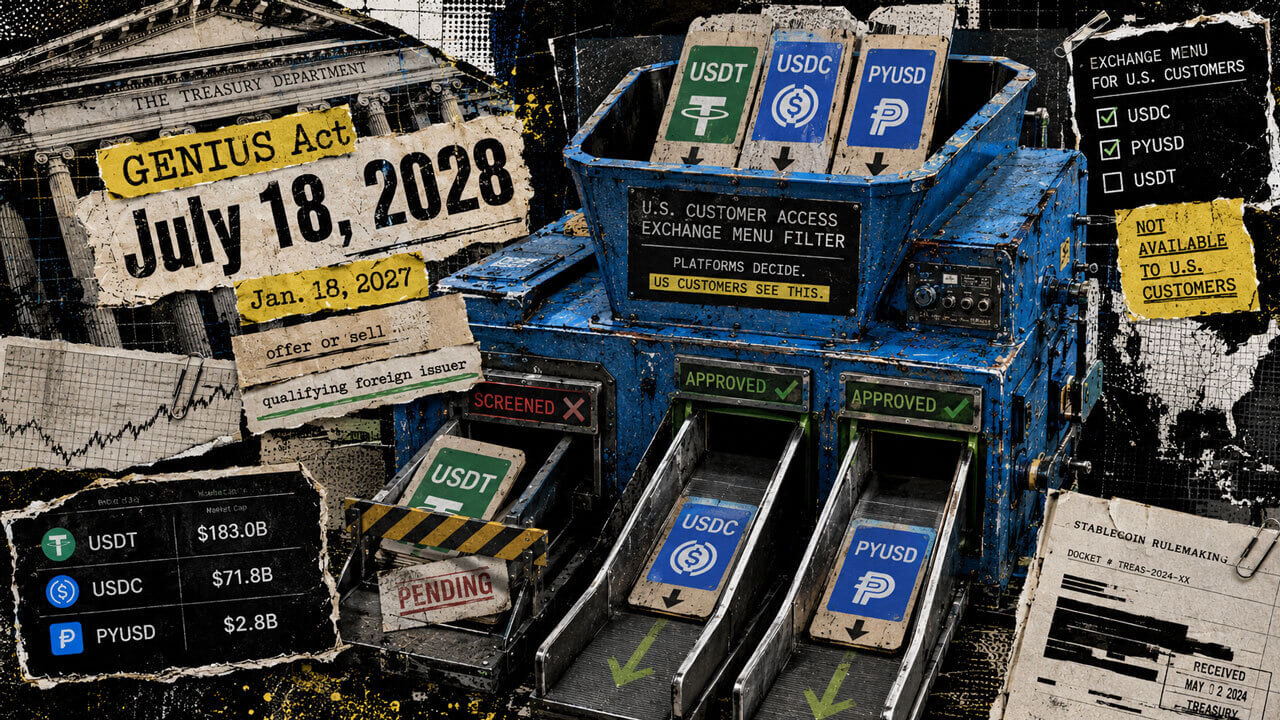
The U.S. Treasury Department has released detailed rules under the proposed GENIUS Act that would limit how offshore stablecoins are offered to U.S. customers. The framework introduces two key dates: January 18, 2027, when issuers must enter the GENIUS regime to sell payment stablecoins in the United States, and July 18, 2028, when broader distribution restrictions take effect.
How the rules work
Under the proposal, a “digital asset service provider” – a category that includes exchanges, custodians, and other platforms that facilitate crypto transactions – would be prohibited from offering or selling a foreign‑issued payment stablecoin to U.S. users after July 18, 2028 unless the token’s issuer qualifies under one of the permitted categories. The rules do not ban the token from circulating on‑chain or being transferred peer‑to‑peer; they focus on regulated businesses that distribute the token to U.S. customers.
Impact on exchanges and custodians
From the January 2027 start date, U.S. platforms must verify that any foreign stablecoin issuer can comply with lawful U.S. orders and has a reciprocal regulatory arrangement with its home jurisdiction. By July 2028, platforms will be required to carry only tokens from issuers that either qualify as foreign issuers under the new criteria or are domestic permitted issuers.
The definition of “offer or sell” is broad, covering advertising, agreeing to a trade, or assisting a customer in circumventing geolocation controls. Consequently, exchanges cannot rely on a customer’s request to justify a sale.
Exemptions and self‑custody
The proposal excludes self‑custody activities such as direct peer‑to‑peer transfers and software that merely helps users hold their own assets. An individual could still receive or hold an offshore stablecoin, but would face friction when attempting to buy, swap, or deposit the token through a regulated service.
Requirements for foreign issuers
Foreign issuers seeking U.S. market access must demonstrate that their home country’s stablecoin regime is comparable to the U.S. framework, register with the Office of the Comptroller of the Currency, and show the ability to comply with U.S. legal orders. This may involve providing evidence that their smart contracts can freeze, seize, or burn tokens when required.
Examples of major stablecoins
- USDT – Issued by Tether from El Salvador; currently available on U.S. exchanges. Tether could pursue qualifying foreign‑issuer status, launch a domestically regulated token (USA₮), or both.
- USDC – Issued by Circle, which holds final OCC approval for its domestic trust structure; likely to follow the domestic permitted‑issuer path.
- PYUSD – Issued by Paxos under a PayPal agreement; also positioned as a domestic permitted issuer.
Exchanges will need to assess the regulatory burden versus the liquidity each token provides when deciding whether to retain them on their U.S. menus.
Next steps
The Treasury has opened a public comment period that runs until October 19. After reviewing feedback, the agency may refine definitions and due‑diligence standards before finalizing the rule.
By the July 2028 deadline, U.S. digital‑asset service providers will be required to document a valid regulatory basis for each stablecoin they offer, shifting the focus from blockchain interoperability to compliance at the point of service.