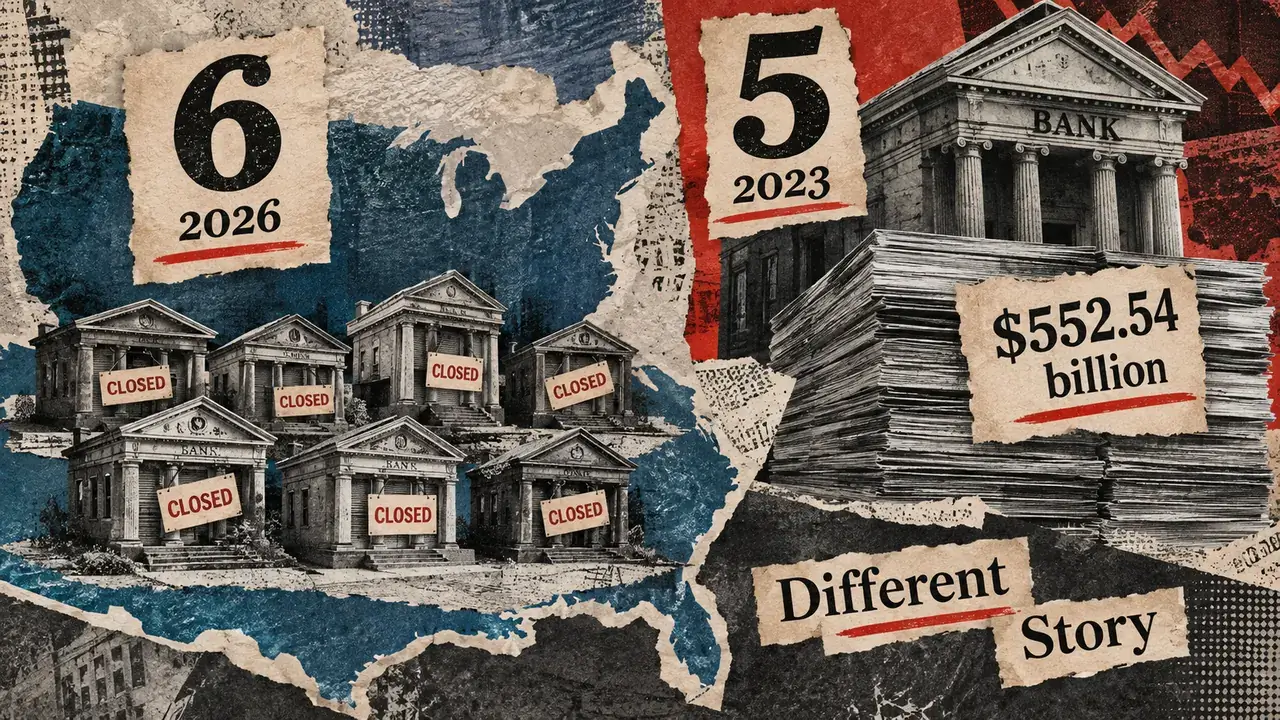
Six US banks have failed so far in 2026, marking an annual count higher than any other year in the decade. However, financial data and historical records from the Federal Deposit Insurance Corporation (FDIC) indicate that the scale of these closures differs significantly from the banking turmoil seen in 2023.
While a simple count of failed institutions suggests a worsening trend, a closer look at the assets involved paints a different picture. The six banks that failed in 2026 held approximately $1.43 billion in combined assets. In contrast, the banks that failed in 2023 held roughly $552.54 billion. The 2026 total includes institutions such as Kentland Federal Savings and Loan Association, described as the country's smallest standalone bank at the time of its closure, which held $3.73 million in assets. Nano Banc's closure on Sept. 25 marked the largest failure of the year, involving $736 million in assets and an estimated $114 million cost to the FDIC's Deposit Insurance Fund.
Regulatory records indicate that these recent closures stemmed from institution-specific challenges rather than a systemic funding shock. Regulators noted issues such as impaired capital, unsafe conditions, and long-standing operational weaknesses at several of the affected lenders, including Metropolitan Capital, Small Business Bank, and Tioga-Franklin.
Meanwhile, the FDIC's broader industry assessments reflect general stability across the wider banking sector. The second-quarter assessment recorded 47 banks on the FDIC's problem list as of June 30, down from 60 at the end of 2025, placing troubled institutions within the normal 1% to 2% range outside of a crisis. Industry-wide profits reached $90.1 billion, and community banks reported an 8.2% increase in earnings compared to the previous quarter.
While the closures carry real consequences for affected customers and the Deposit Insurance Fund—with acquirers stepping in to assume deposits and purchase assets at several of the failed lenders—the available evidence does not establish a widespread contagion or a direct parallel to the systemic strains experienced in 2023.