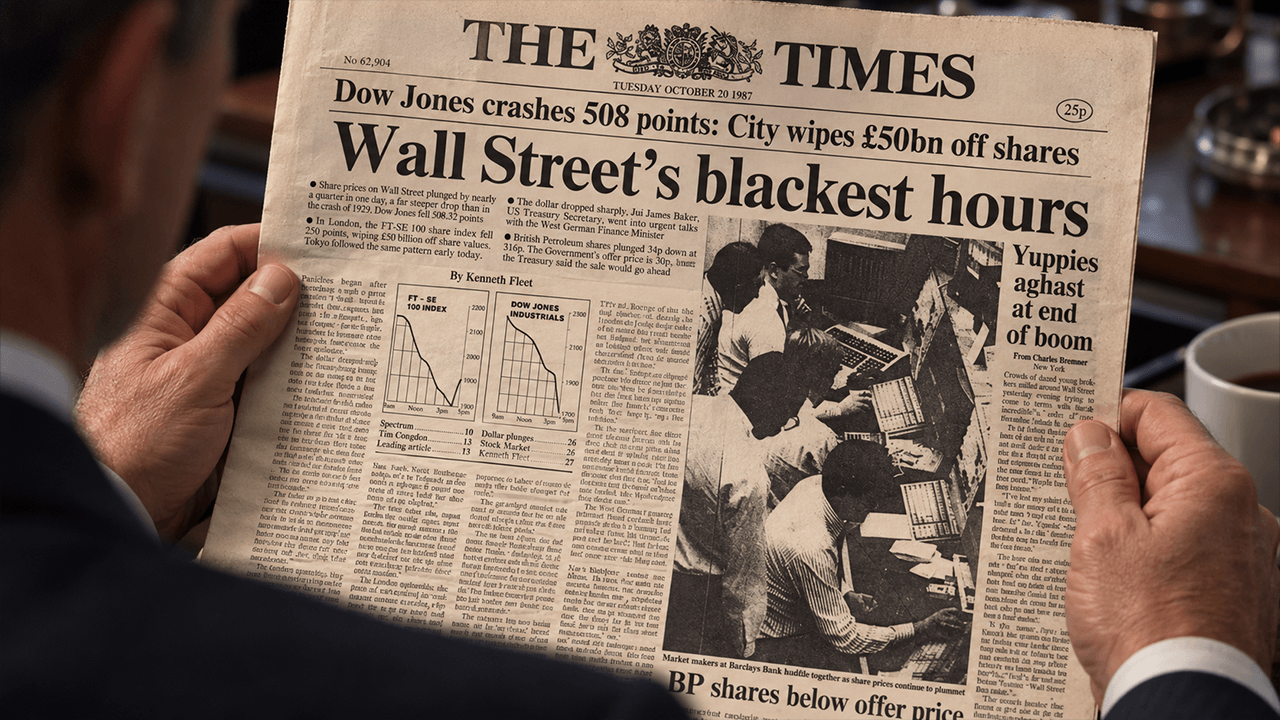
Wall Street confronts an uncomfortable coincidence on Monday, October 19, 2026—the 39th anniversary of Black Monday, when the Dow Jones Industrial Average plummeted 22.6% in a single trading session, the worst one-day percentage decline on record. This time, the anniversary arrives as stocks face pressure from multiple directions: oil trading above $100 a barrel, weakness in artificial intelligence stocks, and inflation concerns that complicate Federal Reserve policy.
The original 1987 Black Monday erased approximately $500 billion from U.S. equity valuations. Automated trading and portfolio insurance strategies amplified selling pressures that day, transforming market weakness into a full-blown rout. Today's concerns echo some of those underlying conditions, including elevated valuations, interest-rate anxiety, and questions about financial leverage.
Current Market Conditions
Recent trading has provided fodder for market anxiety. On Friday, October 16, the S&P 500 closed at 7,659.44, down 1.09%, while the Nasdaq Composite lost approximately 2.2%. Artificial intelligence-related companies absorbed much of the selling pressure, with Coreweave declining nearly 12% as investors questioned the economics of large-scale AI infrastructure investments.
Energy markets have intensified these concerns. Brent crude approached $110 a barrel, while West Texas Intermediate traded above $100 amid geopolitical tensions involving Iran, the Strait of Hormuz, and attacks on energy infrastructure. Higher energy costs threaten to complicate inflation further, with September's consumer price index reaching 3.7% annually. The Federal Reserve's September rate increase placed its benchmark target between 3.75% and 4%.
The Cboe Volatility Index climbed toward 20 as investors sought protection against market turbulence. Meanwhile, gold traded between $4,150 and $4,200 per ounce, and silver hovered near $56 to $58. Bitcoin held near $80,400 to $81,000, displaying relative stability compared with technology-sector losses, while the broader cryptocurrency market stood near $2.7 trillion.
Safeguards in Place
A critical difference separates today's market from 1987: modern safeguards. U.S. stock exchanges now operate market-wide circuit breakers that interrupt trading when the S&P 500 falls 7% or 13%. A 20% decline triggers a trading halt for the remainder of the session. These protections emerged from lessons learned after 1987 and subsequent market disruptions.
Additionally, current selling remains concentrated in technology stocks rather than spreading uniformly across the financial system. Elevated borrowing costs, expensive energy, and heavily financed AI projects represent genuine vulnerabilities, yet these conditions differ substantially from the systemic pressures of 1987.