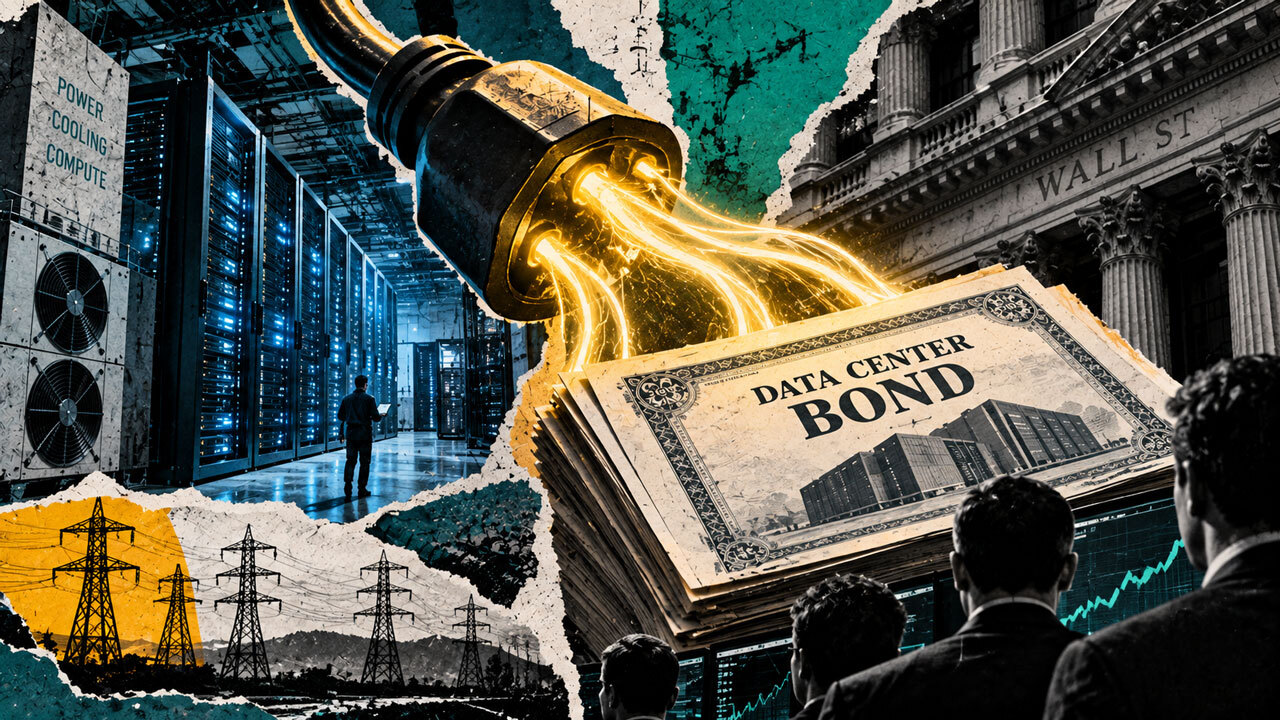
The electricity demands of artificial intelligence have created a new asset class on Wall Street. Data center operators are now converting their revenue streams into bonds, with investors repaid from rent and service fees collected from AI computing tenants after expenses like power, maintenance, and insurance are covered.
The collateral backing these securities extends beyond rental income to include the physical property, power systems, cooling equipment, customer agreements, and the underlying business operations. Power availability and electricity costs shape the bond's value almost as much as tenant creditworthiness, since a secured megawatt in a region with capacity constraints can determine project viability.
Outstanding data-center securitizations have expanded rapidly, growing from roughly $4 billion in 2020 to $61 billion through July 2026, according to Structured Finance Association research drawing on Barclays data. In February, S&P assigned an A(sf) rating to Sabey Data Center Issuer's $475 million notes backed by real estate and tenant lease payments.
Power as the Core Unit
Traditional real estate language struggles to capture what a data center requires. Square footage alone means little without reliable electricity delivery, substations, backup generation, cooling systems, security, and fiber routes designed around each server rack's power draw. For AI companies, a secured megawatt in a power-constrained region can define whether an entire project moves forward.
Lawrence Berkeley National Laboratory estimates that U.S. data centers could consume 649 terawatt-hours in 2030 under its reference case, equal to 11.8% of total U.S. electricity use. Projections range from 521 to 843 terawatt-hours, or 9.5% to 15.3%, depending on chip shipments, server utilization, equipment life, and cooling efficiency.
Tenants typically lease space measured in megawatts and pay for capacity, available power, and operating services. As denser processors pack more heat into each rack, existing facilities may require expensive electrical and cooling retrofits to remain competitive.
From Construction to Securitization
Data centers pass through several financing stages as their risk profile matures. Construction loans, project finance, or private credit fund initial development. Once a facility is operating and leased, the owner can refinance through a data-center securitization or commercial mortgage-backed security.
In a securitization, a special-purpose issuer owns the property, power and cooling systems, fiber, leases, and service contracts while an operator manages daily operations. These structures typically start with debt equal to no more than 70% of appraised asset value, leaving at least 30% as sponsor equity. Notes often carry an expected repayment point around five years and a legal final maturity of 25 to 30 years.
Wall Street divides these pools into classes with different claims on cash flow. Senior classes receive payments first and typically carry lower coupons, while junior classes collect higher interest because they absorb losses sooner. The Structured Finance Association reports average data-center ABS issuance near $600 million and average data-center CMBS issuance near $1.2 billion.
Regulatory Shift
On July 29, the SEC's Office of Structured Finance agreed that certain data-center securitizations fall outside the Exchange Act definition of an asset-backed security. The distinction centers on what remains after investors are repaid: conventional asset-backed securities contain mortgages and loans that disappear as borrowers pay them down, while data centers continue operating and producing value.
This classification allows qualifying deals to avoid several ABS-specific obligations, including rules requiring securitizers to retain 5% of credit risk and provisions barring certain conflicts of interest. Federal antifraud law and relevant registration exemptions still apply, leaving investors to analyze power contracts, tenant concentration, refinancing assumptions, and asset conditions.
Capital Requirements and Future Growth
Morgan Stanley estimates $2.9 trillion in global data-center spending through 2028, with roughly $1.4 trillion covered by cash generated at large cloud companies and $1.5 trillion needing external finance. Securitizations and commercial mortgage bonds could supply around $150 billion, with corporate debt, bank loans, project finance, and equipment lending funding the remainder.
Data-center securitizations have grown to about 12% of the esoteric ABS market in 2026, up from 3% in 2020. A Barclays projection cited in industry reports puts outstanding data-center securitizations as high as $180 billion by the end of 2028.
The bond investor's claim stretches across decades, connected to utilities, substations, leases, servers, and refinancing assumptions. Every coupon now carries the physical constraints of power delivery and computing demand that the AI interface itself leaves invisible.