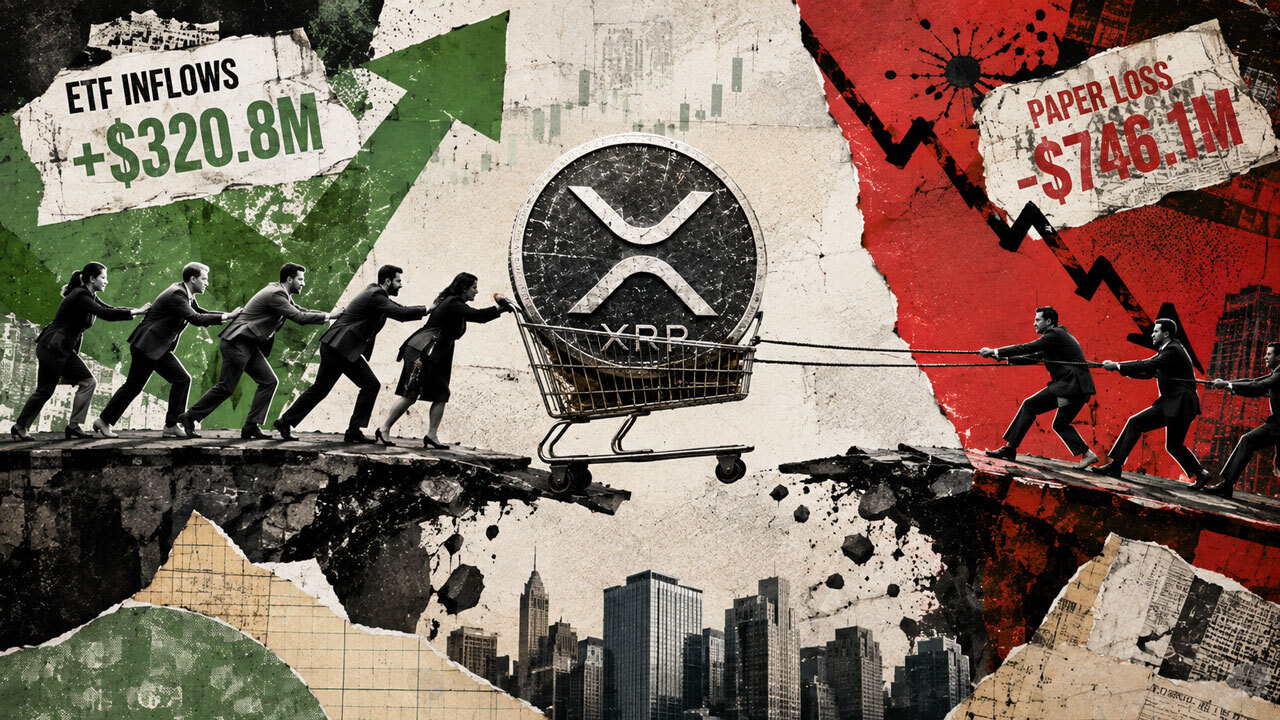
Five major US spot XRP products—Bitwise, Canary Capital, Franklin Templeton, 21Shares, and Grayscale—held XRP with a combined fair value of $746.1 million below their accounting cost as of June 30, yet investors continued purchasing shares throughout the first half of the year.
According to SEC filings, the five funds recorded $629.9 million in primary-market share creations against $309.1 million in redemptions during the period, leaving net capital activity positive by approximately $320.8 million. This inflow occurred despite the funds' combined XRP holdings trading 44.1% below their $1.7 billion accounting cost, with a fair value of $947.3 million as of June 30.
Divergent Patterns Across Funds
The aggregate net inflows masked significantly different activity at individual funds. Bitwise, Canary, and Franklin recorded $537.9 million in creations against $53.3 million in redemptions, producing net inflows of $484.5 million. Only about $9.90 redeemed from these three funds for every $100 that came in.
By contrast, Grayscale and 21Shares recorded net outflows of $163.7 million. Grayscale alone saw $180.8 million redeemed against $66.6 million created, while 21Shares recorded $75 million in redemptions against $25.5 million in creations. These two funds accounted for approximately 83% of all redemptions across the five-fund sample.
The Cost-Basis Question
The five funds held approximately 906.8 million XRP at June 30, implying a rough cost-basis breakeven near $1.87 per token. At the time of analysis, XRP was trading around $1.38, meaning the sample remained underwater at that price.
Cumulative XRP ETF inflows across the broader product category reached $1.8 billion by the end of August, according to Bloomberg ETF analyst James Seyffart, described as surprisingly resilient demand given the accounting losses present in the funds' holdings.
What Recovery Would Require
For the five-fund sample to approach its cost basis, XRP would need to recover to approximately $1.87. A recovery to $1.50 to $1.90 would erase most of the accounting gap, while a decline to $0.75 to $0.90 would push the sample 52% to 60% below cost and potentially trigger wider redemptions beyond the funds already experiencing outflows.
The pattern reflects conviction buying into a known loss during the first half of the year, though whether that conviction was broadly shared or concentrated among specific funds remains dependent on XRP's price trajectory going forward.