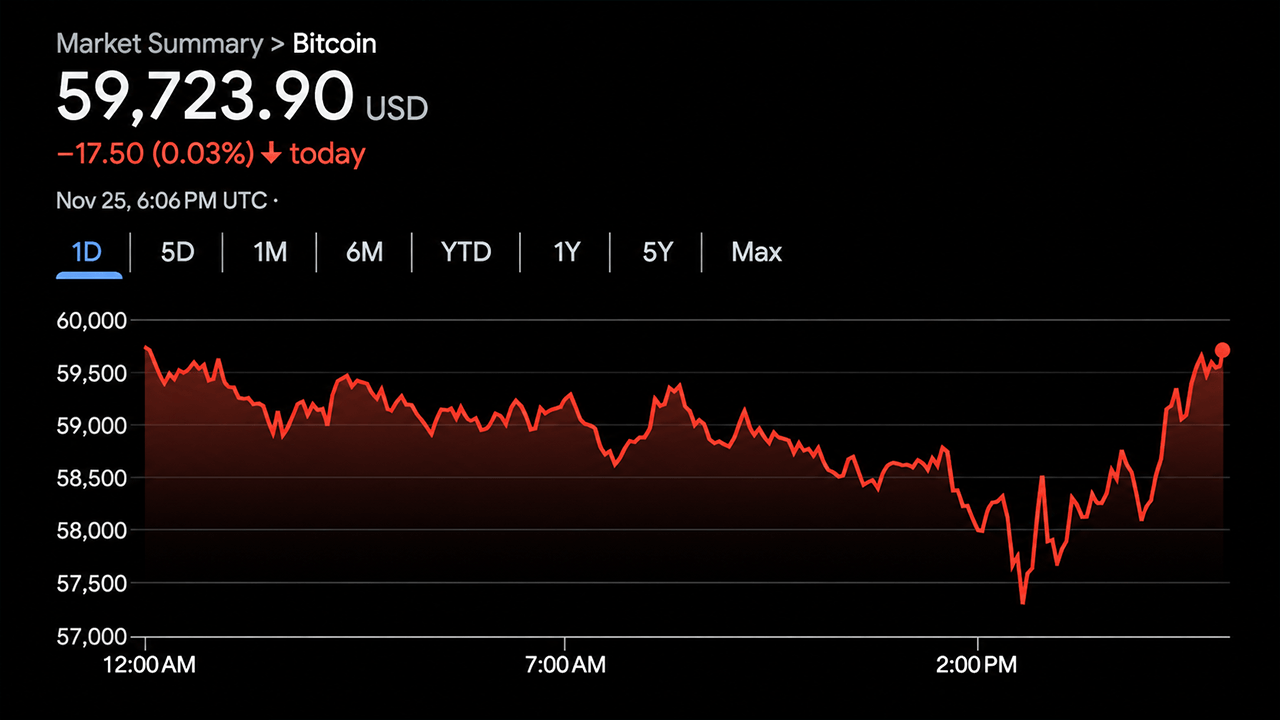
Bitcoin fell for a second consecutive day Wednesday, sliding to an intraday low of $57,209 as renewed concerns over U.S. tariff policy sparked a broad sell-off in risk assets. By 1:15 p.m. EST, the cryptocurrency traded near $59,723, marking a 1% decline over 24 hours and extending losses from earlier in the month.
The downturn has erased roughly $95.5 billion from bitcoin's market capitalization since early November. Bitcoin is now down 7.41% from Monday's peak of $64,505 and nearly 25% since the start of the month.
Liquidations Surge Across Crypto Markets
The price decline triggered heavy derivatives liquidations across the cryptocurrency market. Bitcoin liquidations exceeded $213 million, with nearly $138 million stemming from long positions. Total liquidations across all cryptocurrencies reached $579 million, comprised of $407 million in long positions and $172 million in short positions.
Spot Demand Critical to Market Stability
Bitfinex analysts highlighted that the decisive factor over the next two weeks will be whether unleveraged spot demand returns before crowded long positions are forced to unwind. The firm warned that if spot buyers remain sidelined, options positioning suggests dealer hedging could accelerate downside momentum into the $58,000 to $64,000 range.
Bitcoin was already trading near the lower end of that range Wednesday, underscoring the vulnerability of a market increasingly supported by leverage rather than fundamental buying pressure.
Inflation Weighs on Recovery Prospects
Persistent U.S. inflation continues to pressure risk assets. October's personal consumption expenditures report showed both headline and core inflation rose 0.3% from the previous month, while annual core PCE inflation reached 3.3%, exceeding forecasts of 3.2%.
Analysts noted that slower-than-expected inflation cooling creates a difficult backdrop for cryptocurrency markets by reducing the prospect of near-term Federal Reserve rate cuts and potentially keeping liquidity conditions restrictive.
Structural Shift to Leverage as Spot Investors Exit
Bitcoin has increasingly relied on leveraged trading as spot investors retreat. Since the Nasdaq-100 reached its all-time high on October 6, bitcoin has underperformed during equity rallies while suffering steeper losses during downturns. Over 35 trading days, bitcoin gained an average of just 0.49% on days the index rose, compared with the index's average gain of 1.67%, while losing an average of 1.87% on down days.
Investors have withdrawn nearly $5 billion from spot exchange-traded funds over the past month, contributing to the shift toward leveraged positioning and creating structural fragility in a market increasingly dependent on rising open interest and positive funding rates.
Corporate Buyers Shift Focus to Balance Sheet Defense
Institutional and corporate demand is also showing signs of strain. Strategy, one of bitcoin's largest corporate buyers, launched a BTC Monetization Program in June that allows bitcoin sales to fund reserves, dividend payments, and share buybacks. While Strategy maintains $4.8 billion in U.S. dollar assets and has not engaged in forced selling, analysts note that the company's approach reflects a broader shift toward balance sheet management over continued accumulation.
Other corporate treasury activity has become increasingly uneven. Japan's Metaplanet repurchased roughly 7% of its outstanding stock, while U.K.-based Satsuma Technology was liquidated by its owners, illustrating how market conditions are reshaping corporate bitcoin strategies.