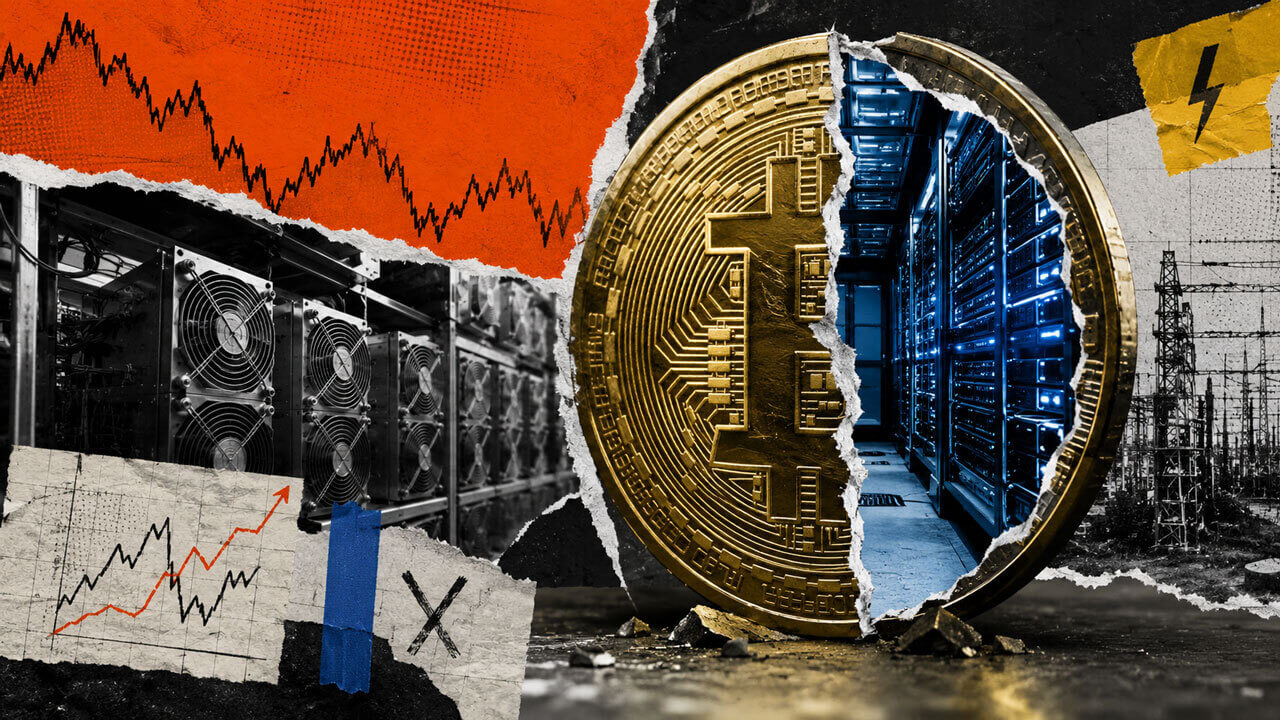
Large US-listed Bitcoin miners are increasingly diverging from the price of Bitcoin as their business models pivot toward high-performance computing (HPC) and artificial intelligence infrastructure. While the sector originated from converting electricity into Bitcoin, many firms now lease power, land, and grid capacity to hyperscalers.
Diverging Market Performance
The shift was highlighted during a notable market stretch when Bitcoin gained 21.5%, yet six out of seven large US-listed miners finished the period lower. While MARA Holdings tracked closer to Bitcoin with a 16.1% gain, other firms such as Cipher Digital, TeraWulf, Hut 8, and IREN experienced declines ranging from 6.8% to 14.8%. Analysts noted that these stocks have begun to trade more consistently with broader technology-equity proxies like the QQQ index rather than acting as pure crypto proxies.
Evolving Revenue Mix and AI Contracts
Power has become the scarce input sought by both the crypto mining and AI industries. Public miners are at various stages of converting their operations to support GPU clusters alongside or instead of ASIC miners:
- TeraWulf: Generated $31.9 million of its $44.8 million second-quarter revenue from high-performance-computing leases, with the remainder from digital assets.
- IREN: Reported $70.5 million in AI cloud revenue compared to $66.7 million in Bitcoin mining revenue for its June quarter, alongside a $450.4 million impairment largely tied to decommissioned mining hardware.
- Hut 8: Reported Beacon Point leases covering 949 megawatts of contracted IT capacity with significant base-term contract value.
- Cipher Digital: Contracted 700 megawatts of high-performance-computing capacity across three sites while continuing to record mining revenue.
- Riot Platforms: Reported $113.7 million in mining revenue alongside $23.2 million from data centers and $37.3 million from engineering.
- CleanSpark: Signed a long-term data-center lease while its operating revenue remained anchored in mining, entering the hybrid group.
Shifting Betas and Future Outlook
Historical data analyses show that Bitcoin correlation and beta have generally declined across most of the group as data-center contracts gained financial weight. However, metrics vary widely across the sector. MARA retains the group's highest Bitcoin correlation and beta, reflecting its heavier reliance on traditional mining economics, whereas firms with larger contracted data-center footprints occupy the lower end of Bitcoin correlation.
Ultimately, analysts suggest that the term "Bitcoin miners" describes these companies' origins more accurately than their current destination, as investors now gain exposure to a mix of Bitcoin production, tenant credit, construction schedules, and technology-equity multiples.