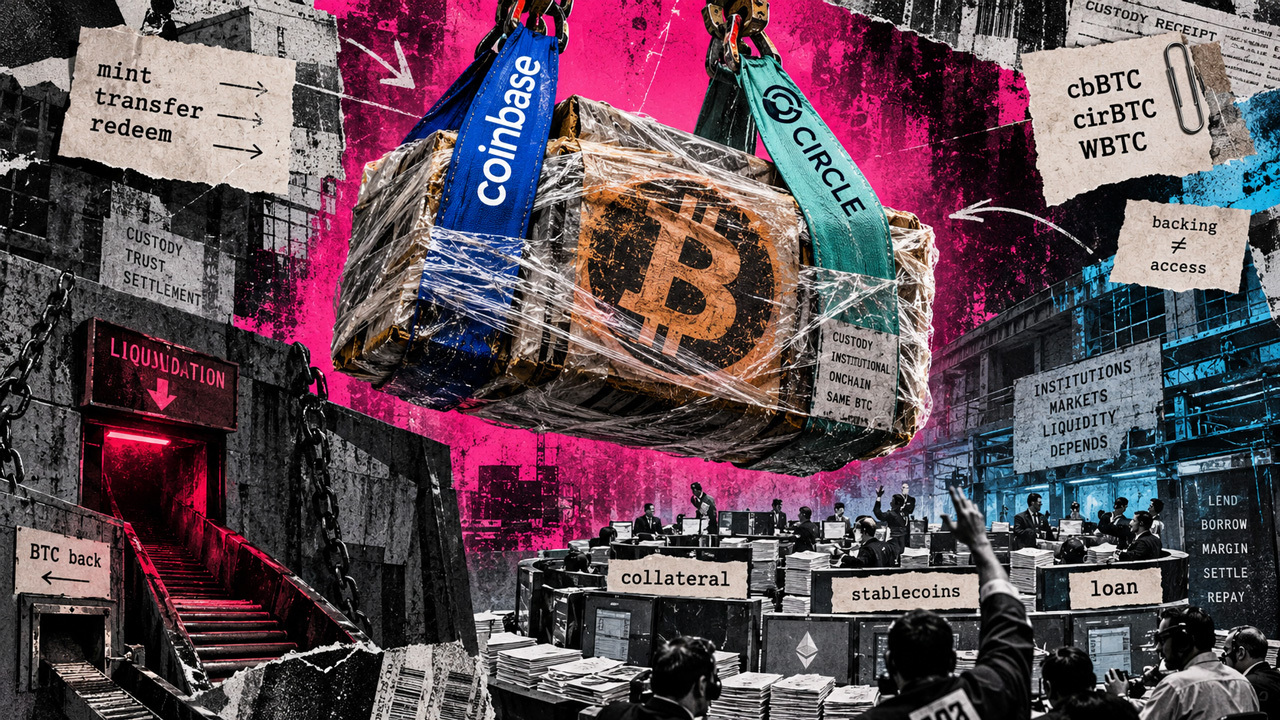
Bitcoin holders who need cash can borrow against their holdings rather than selling them, maintaining exposure to the asset while using its value as collateral. Because many blockchain lending applications operate on networks like Ethereum, which cannot directly access Bitcoin's network, owners often rely on custodial wrappers to bridge the gap.
How Wrapped Bitcoin Works
A custodial solution involves entrusting Bitcoin to a custodian for safekeeping in exchange for a digital token that lending applications can accept. The original Bitcoin remains in custody while a transferable token represents it on another network. Products such as WBTC, Coinbase's cbBTC, and Circle's cirBTC offer competing versions of this arrangement.
The deposit-and-redemption process typically involves minting and burning tokens. Once deposited, a corresponding token is minted on another network. Redemption reverses the process by removing the token from circulation and releasing the Bitcoin through provider procedures. BitGo, for example, utilizes approved businesses called merchants to handle conversions with custodians for WBTC.
Because each token is intended to be worth one Bitcoin, wrapping does not protect holders from market price declines. The primary mechanism keeping the token price close to Bitcoin is the ability to redeem it. If a wrapped token trades below its backing, traders can buy and redeem it for Bitcoin to earn the difference. However, restrictions or delays can weaken this process, as knowing Bitcoin exists does not guarantee immediate retrieval.
Using Collateral in Lending Applications
Once a token reaches a lending application, smart contracts can accept it as collateral to let users borrow dollar-linked stablecoins. Borrowers must pledge more value than they borrow to account for potential price drops. If the Bitcoin price falls significantly, the buffer may become inadequate, triggering a liquidation where the application sells collateral to reduce the debt. This can result in the loss of Bitcoin exposure that the borrower sought to avoid.
Wrapping itself pays no interest, meaning holders seeking income must engage in further activity, such as lending the token out, which introduces additional risks. Different providers feature distinct integration methods:
- WBTC: Relies on a merchant network to connect exchanges and institutions to its minting and redemption process.
- cbBTC: Integrates conversion directly into existing Coinbase accounts for eligible customers withdrawing or depositing via supported networks.
- cirBTC: Targets institutional clients, connects with Circle services and USDC, keeps Bitcoin separate from corporate assets, and uses Chainlink to publish reserve data.
Evaluating Risks and Dependencies
While providers often publish reserve dashboards—such as Coinbase's cbBTC reserve view—visible reserves do not guarantee what happens if a provider fails or if every holder can redeem tokens immediately. Owning a wrapped token means controlling the digital keys to the token, while a custodian controls the keys to the underlying Bitcoin.
Adding a loan into the process introduces further reliance on the software managing the position. Smart contracts must execute rules correctly and value collateral using reliable prices. Ultimately, while wrapping makes Bitcoin usable in applications that otherwise could not accept it, it requires navigating fees and reliance on multiple institutions and software systems.