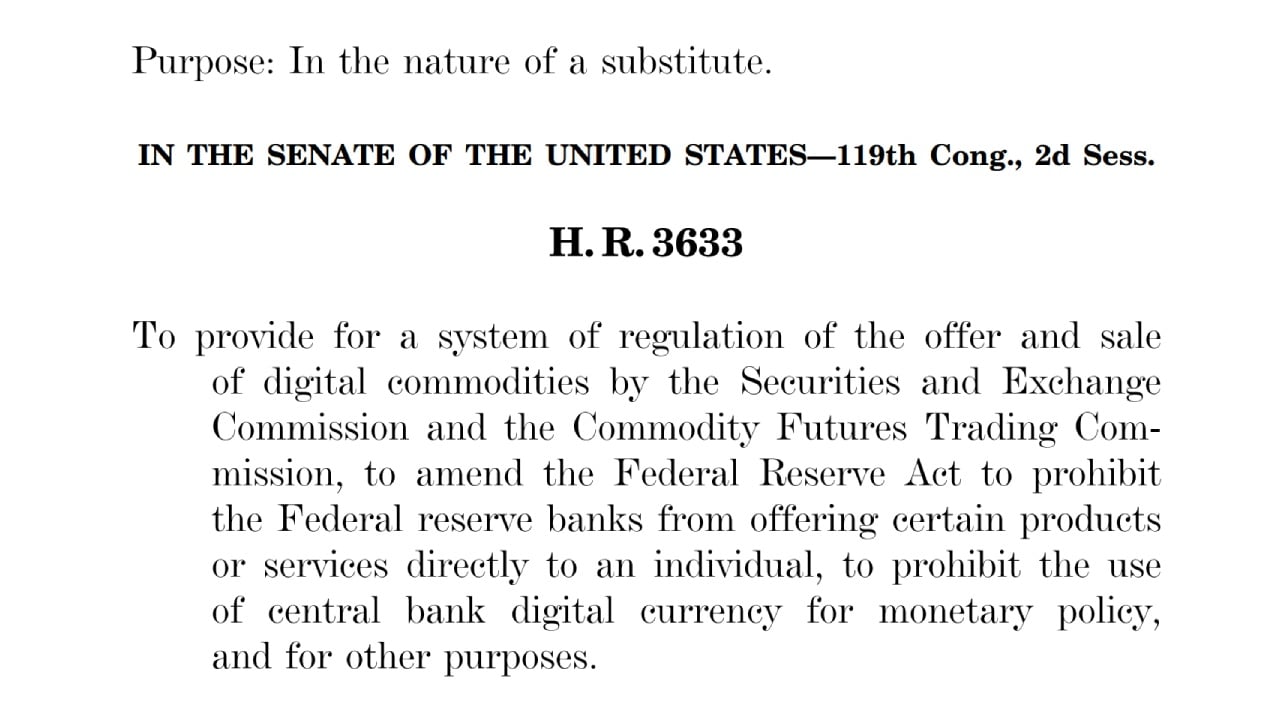
The Digital Asset Market Clarity Act has become marginally more likely to pass following Senate Republicans' release of a revised regulatory framework. Prediction market Polymarket odds for the bill's passage in 2026 climbed to approximately 30% after the September 10 unveiling, up from levels in the mid-20s where they had remained through most of the summer.
The new Senate draft spans 630 pages and incorporates more than 114 provisions that Democrats had requested. This represents a significant concession from Senate Republicans, suggesting leadership prioritized securing the 60 votes needed for passage over ideological consistency.
Key structural changes
The revised bill requires non-decentralized trading protocols to register with the Commodity Futures Trading Commission. It also narrowed DeFi provisions to focus specifically on spot and cash transactions.
A cloture vote is scheduled for September 15 at 2:15 p.m. ET. With Republicans holding 53 Senate seats, passage requires at least 7 Democratic senators to cross the aisle to reach the 60-vote threshold needed to clear cloture.
Legislative timeline
The House passed its version of the bill, H.R. 3633, on July 17, 2025, with a 294-134 vote. The Senate Banking Committee advanced the bill on May 14, 2026, with a 15-9 vote.
The inclusion of Democratic provisions signals Republican recognition that the bill cannot pass on party-line support alone. Some provisions reportedly address consumer protections and ethics requirements.
Regulatory implications
The CFTC-centric approach would reshape competitive dynamics among U.S. regulators. Historically, the SEC has taken an aggressive stance toward crypto enforcement, filing suits against major exchanges and arguing that most tokens qualify as securities. Transferring primary oversight of non-decentralized trading platforms to the CFTC would represent a meaningful shift in regulatory authority between the two agencies.
Market odds have fluctuated throughout 2026 as partisan disagreements over DeFi regulation and CFTC authority created significant obstacles. If the bill fails to clear 60 votes on September 15, months may pass before another attempt materializes, potentially shifting the timeline into 2027 and a new congressional session.