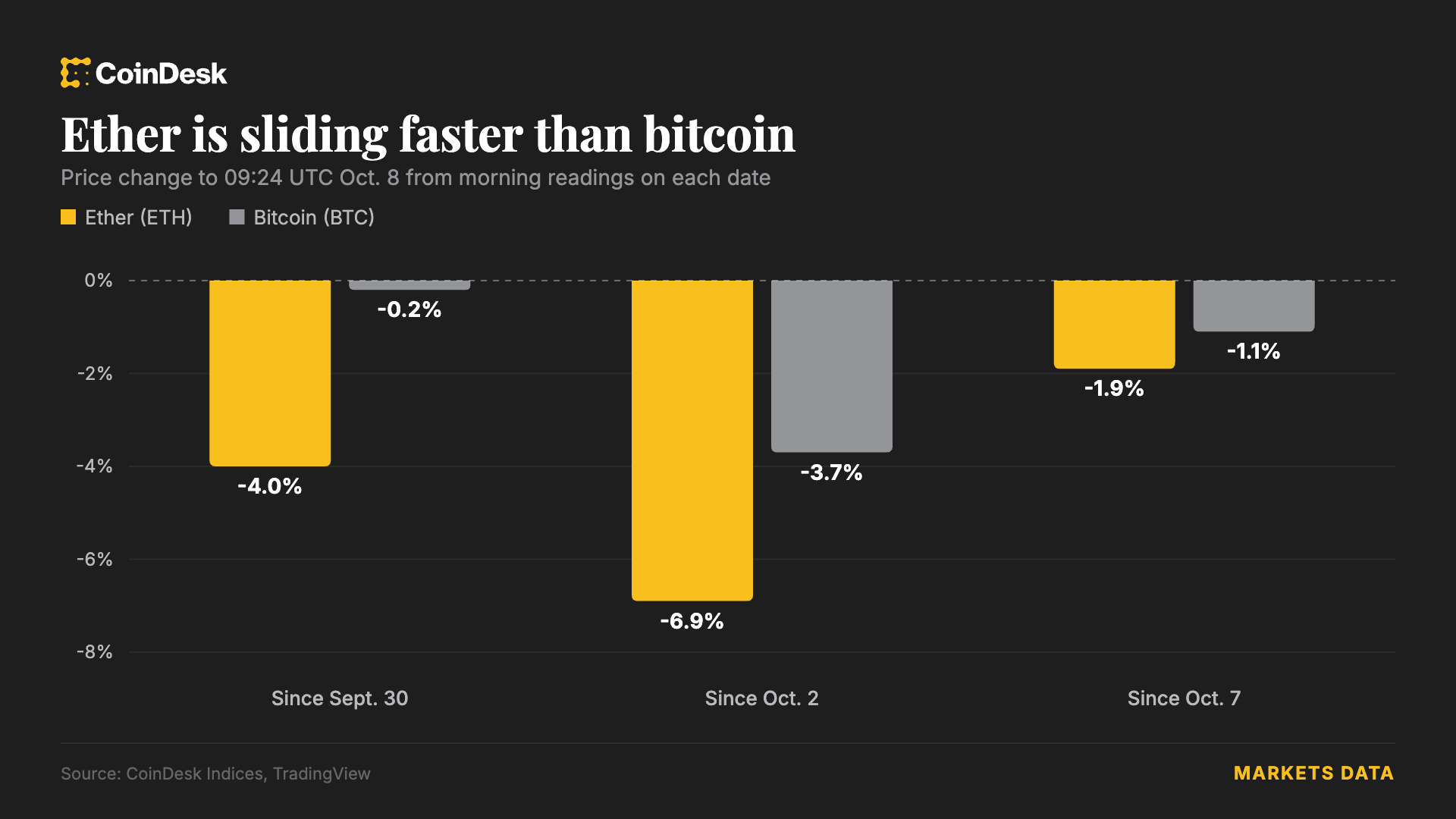
Ethereum has broken out of a two-week trading band, shifting the short-term trend in favor of sellers. The asset rose from a low of $2,380 to nearly $2,810 before establishing a new trading floor at $2,625–$2,650. On October 7th, large-volume selling broke through both support levels, triggering further declines.
Ethereum subsequently found temporary support at $2,535 and $2,559. The $2,559 level holds particular significance because it served as a starting point for an earlier advance on September 20th. Trading volume reached its highest point during the recent band, confirming increased selling pressure.
If Ethereum holds at $2,565, analysts suggest potential recovery toward the $2,625–$2,650 range. A break below this level would expose $2,500, followed by $2,380–$2,400, further weakening the recovery outlook and increasing pressure on buyers.
Institutional Demand Shifts Away From Ethereum
Ethereum's weakness has been amplified by institutional ETF flows. On October 6th, BlackRock's Ethereum ETF (ETHA) recorded $201.89 million in outflows, while its Bitcoin counterpart (IBIT) attracted $122 million. Across the broader market during this period, Bitcoin ETFs gained $119 million in net flows, while Ethereum ETFs lost $201.89 million.
Bitcoin has captured the majority of institutional inflows despite a broader risk-off environment. Ethereum's stabilization would require an increase in money flowing into its ETF to restore institutional confidence.
AI and Security Considerations
Beyond market dynamics, Ethereum faces emerging security questions as AI advances. Ethereum Foundation core researcher Justin Drake warned that AI could accelerate cryptographic threats to ECDSA sooner than previously expected. Ethereum co-founder Vitalik Buterin acknowledged this risk while cautioning against panic-driven migrations, noting that rushed wallet moves can create new security vulnerabilities.
Ethereum's security teams are using AI to test protocol code and identify weaknesses, with one disclosed vulnerability (CVE-2026-34219) demonstrating how automated testing can expose issues. Attackers are also deploying AI to scan unverified contracts more efficiently, underscoring the need for stronger defenses as AI capabilities advance.