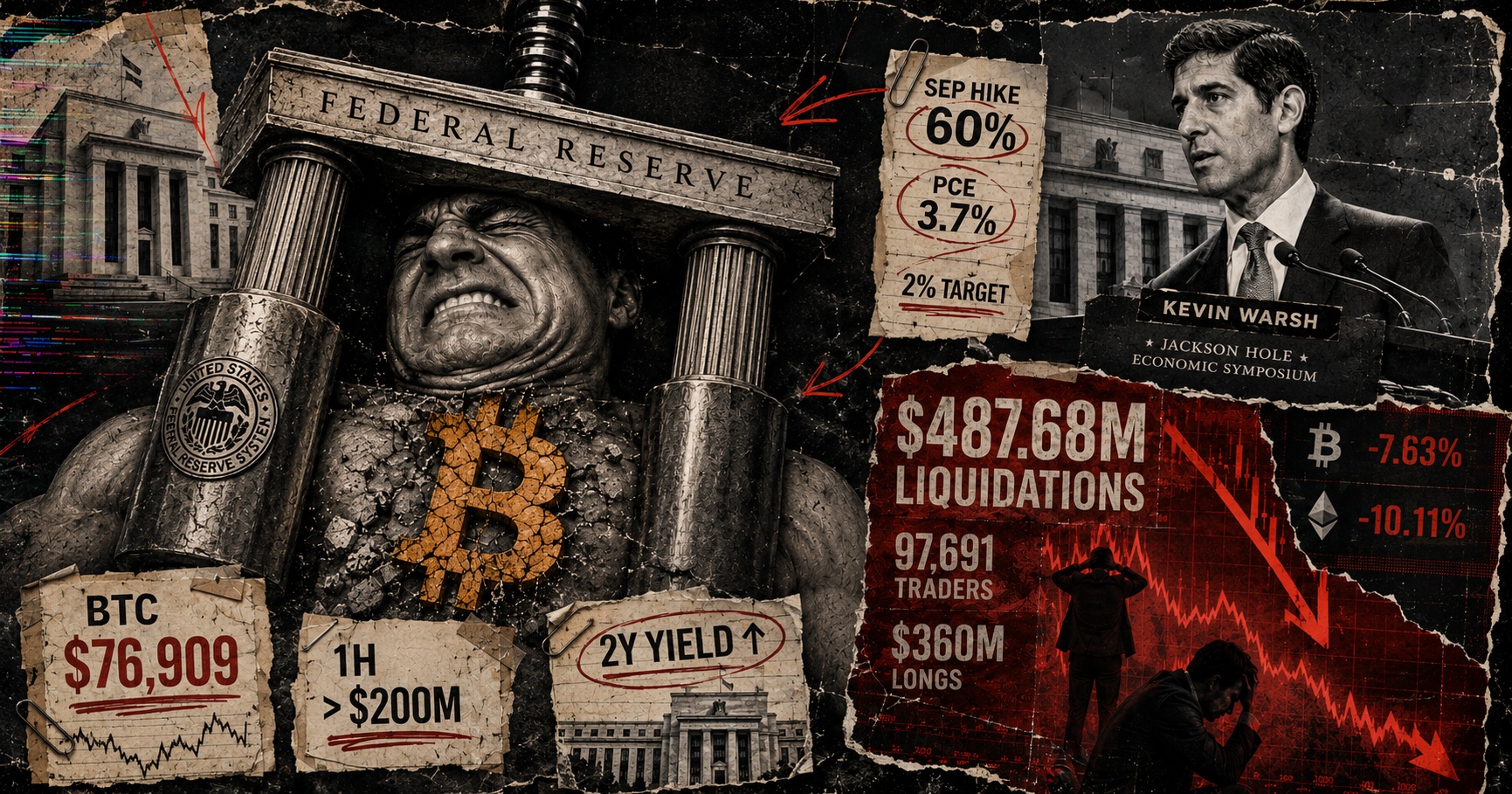
Bitcoin dropped to as low as $76,909 on Friday following remarks by Federal Reserve Chair Kevin Warsh at Jackson Hole, marking a roughly 4% decline over the previous 24 hours. The decline accelerated a broader crypto market deleveraging that erased nearly $488 million from derivatives traders across 97,691 positions.
Warsh argued that inflation remains too high despite recent price improvements, with the Fed's preferred personal consumption expenditures price index running at 3.7% annually and 4.1% on an annualized six-month basis, both well above the central bank's 2% target. He stated that the Fed must be confident underlying inflation is moving toward its objective "clearly and at sufficient speed," otherwise "we have work to do."
The Fed chair also challenged the view that current financial conditions were sufficiently restrictive, noting that credit markets show few signs of policy restraint, corporate bond spreads remain historically narrow, and bank lending standards are relatively easy. "I would be hard pressed to describe broad financial conditions as restrictive," Warsh said.
Markets responded swiftly to Warsh's remarks. Traders lifted the probability of a September rate increase to approximately 60% from roughly 35% before his speech. Short-term Treasury yields rose and the dollar strengthened in response.
The liquidation hit a crypto market that had entered Friday with substantial leveraged exposure following Bitcoin's recent rally above $80,000. CoinGlass recorded $487.68 million in liquidations, with more than $200 million in positions closed within one hour after Warsh's speech. Long positions accounted for more than $360 million of the losses, indicating that traders positioned for further gains absorbed most of the reversal. Bitcoin positions generated approximately $141 million of the liquidations, while the largest individual liquidation was an $11.66 million ETH-USDT position on Binance.
Higher interest-rate expectations create multiple headwinds for crypto assets. Rising Treasury yields increase returns available on dollar-denominated assets, while a stronger dollar typically tightens financial conditions for speculative markets. More restrictive policy expectations can also reduce the liquidity backdrop that supported Bitcoin's recent advance.
Warsh offered little certainty about the Fed's next move, having moved away from forward guidance used by his predecessors. He rejected the idea of providing investors with a mechanical reaction function dictating how rates should respond to individual economic reports. This approach could make upcoming inflation and employment releases more consequential for Bitcoin and other risk assets, as traders will have fewer Fed signals about how policymakers intend to respond.