GnosisDAO has approved a governance plan to retire Gnosis Chain's standalone Layer 1 network and transition into a zero-knowledge-proven Ethereum Economic Zone rollup. The shift will ultimately remove the network's independent validator set and allow Gnosis Chain to inherit security directly from Ethereum validators every block.
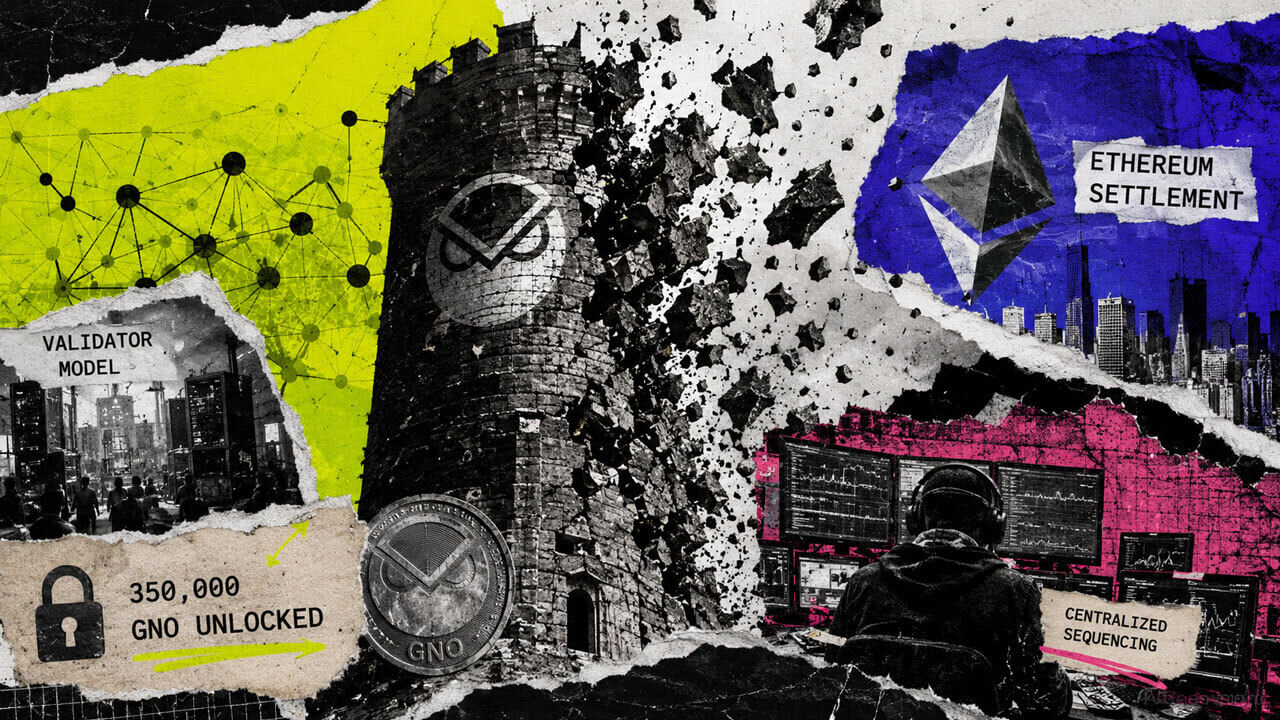
Under the approved proposal, designated as GIP-153, roughly 350,000 staked GNO tokens will be unlocked. While these tokens are already counted in the circulating supply, ending the staking mechanism makes them liquid again and removes their function in securing Gnosis Chain. Following the decision, GNO rose 10% to reach approximately $136, its highest level since May.
The approval currently serves as a direction-level mandate rather than a final launch decision. Funding and a completed technical design were not approved under the measure. The first version of the Ethereum Economic Zone is targeted for launch between December 2026 and January 2027, contingent upon necessary infrastructure readiness.
Token Economics and Integration
The transition requires a redesign of GNO's tokenomics. Gnosis currently funds validator rewards from its treasury because network fees cover only a fraction of security costs, an arrangement that dilutes non-stakers by an estimated 2.3% annually according to GIP-153. Once the independent validator set is retired, the staking subsidy will end, and Gnosis plans to link GNO to revenue generated by the rollup.
Specific mechanisms for the new economic model have not been finalized, though options under consideration include fee sharing or GNO buybacks tied to network revenue. A separate governance proposal will address these details once the economics of operating the rollup become clearer.
The strategic objective is to connect applications directly to Ethereum's liquidity without requiring users to bridge assets between separate networks. Planned synchronous composability would permit a Gnosis contract to call an Ethereum contract and utilize the result within the same atomic transaction.
Martin Koeppelmann, Co-Founder and CEO, stated that the initiative allows Gnosis to avoid fragmented scaling paths. Following the transition, mainnet wallet users will be able to interact with Gnosis dapps in a single transaction without bridges.
Several decentralized finance projects, including Aave, Spark, Fluid, CoW Swap, Safe, and Centrifuge, have committed to developing consumer-focused products within the environment.
Decentralization Trade-Offs
The transition involves a structural trade-off regarding decentralization. While settlement and proofs will move to Ethereum, Gnosis Ltd. is expected to initially operate the sequencer responsible for ordering transactions and producing blocks. GIP-153 characterizes this move toward a less decentralized execution layer as a deliberate choice.
For GNO holders, the shift replaces an established source of token utility with an unfinished revenue model while simultaneously releasing a large block of staked tokens back into liquid markets.