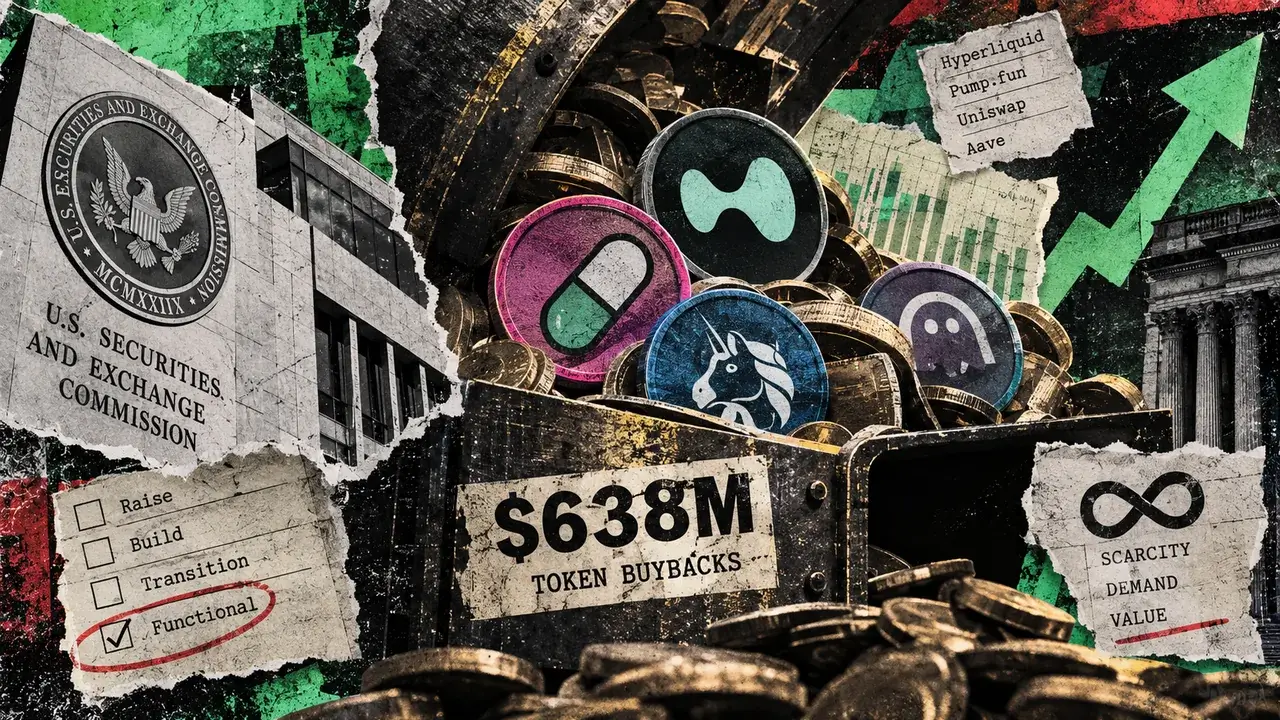
Crypto projects spent approximately $638 million on token buybacks through late August 2026, according to Allium Labs data—a record exceeding the $545 million spent over the same period in 2025. Hyperliquid and Pump.fun accounted for roughly 90% of total buyback activity, with $370 million and $200 million respectively.
On September 25, the Securities and Exchange Commission's Division of Corporation Finance released guidance addressing the regulatory treatment of these programs. The SEC clarified that buyback announcements for non-security crypto assets on functional networks fall outside the scope of "essential managerial efforts" analyzed under the Howey test for investment contracts. However, the agency cautioned that projects on networks not yet operational should avoid marketing buybacks as a source of yield or returns, as such claims could trigger securities law analysis.
A Regulatory Framework Takes Shape
The SEC's guidance rests on two assumptions: a functional network and a token already classified outside securities law. The agency's March interpretation defined a functional network as one where a native token can be used according to its programmed utility.
The pending Regulation Crypto Assets proposal would establish a regulatory life cycle for token projects. Under proposed exemptions, projects could raise up to $5 million over four years under a startup exemption, or up to $75 million every 12 months under a larger fundraising exemption. The proposal includes Proposed Rule 400, which creates Form TR, a transition filing in which issuers certify that promised managerial efforts have been completed or permanently ceased. The SEC could later contest whether conditions were actually met. Based on 15% of roughly 3,165 projects launched in 2024, the agency estimates approximately 475 issuers annually could rely on that safe harbor. Comments on the proposal close October 20.
Current Buyback Scale and Mechanics
Pump.fun allocates 50% of its revenue to buying and burning PUMP tokens. The platform reported roughly $500 million in annualized revenue and approximately $462.5 million in cumulative purchases, with 167.7 billion tokens destroyed, equivalent to 16.8% of the original supply.
Hyperliquid has bought and burned roughly $1.3 billion of HYPE since launch. Documentation indicates more than $1 billion in annualized fees now flows into programmatic HYPE purchases, though the protocol also funds staking rewards from future emissions.
Uniswap activated protocol fees on Ethereum mainnet in December 2025 and has since extended them to other chains, with fees accumulating for searchers who burn UNI to obtain them.
Aave acquired more than 205,000 AAVE tokens, approximately 1.28% of supply, for roughly $42 million in its first ten months. The DAO paused purchases on April 19 following the rsETH bridge incident to preserve balance-sheet flexibility as revenue softened and governance considered reducing the annual budget.
Token Ownership and Rights
Digital commodity tokens like HYPE, PUMP, and UNI generally provide holders no inherent right to passive yield, future income, or profits. Governance can redirect or pause buyback programs at any point. Uniswap's documentation states that value reaches UNI holders through the burn mechanism and whatever future mechanisms governance approves, while protocol revenue remains under the protocol's control.
The distance from securities law that enables easier trading of mature tokens also separates them from the cash flows investors traditionally use to value assets. Bitcoin, which the SEC lists as a digital commodity, runs without an issuer or protocol revenue to recycle.
Scale Relative to Traditional Markets
Crypto buyback spending remains significantly smaller than traditional markets. S&P 500 companies spent $1.02 trillion on repurchases in the 12 months through September 2025. Crypto spending rose from approximately $366,000 in 2024 to $638 million in under eight months of 2026, with mechanisms that automatically convert revenue into market purchases.
Path Forward
If the SEC finalizes Regulation Crypto Assets close to its current form, teams can raise capital under the exemptions, establish finite roadmaps, file transition reports, and deploy revenue into token purchases once networks become functional. At current run rates, industry buybacks could exceed $1 billion annually. If the proposal stalls or emerges in weaker form, the nonbinding staff FAQ becomes the primary source of regulatory comfort, and projects would likely avoid return language in marketing while treating buybacks as discretionary.