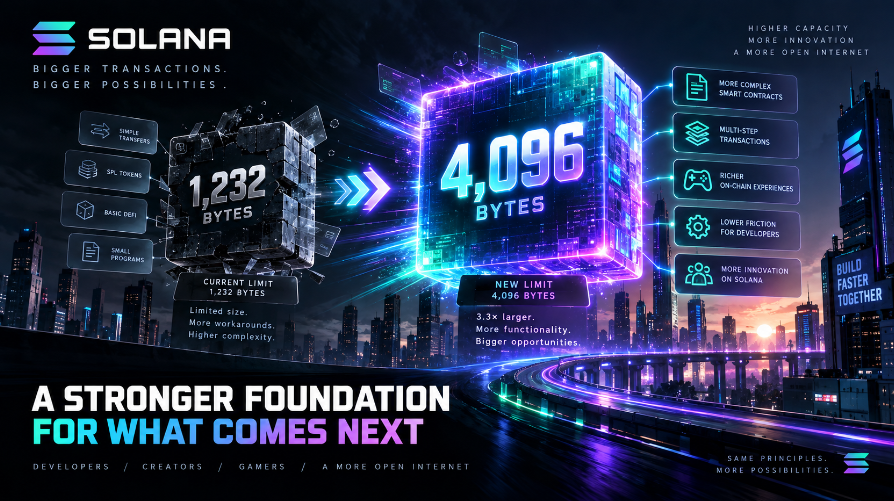
The Solana Foundation is preparing a new v1 transaction format that raises the maximum transaction size from 1,232 bytes to 4,096 bytes—roughly 3.3 times the current ceiling. Legacy and v0 transactions remain unchanged, while developers who need the additional space can opt into the new format.
Solana's 1,232-byte ceiling dates back to a practical networking decision. The chain originally kept transaction payloads small enough to fit within a conservative IPv6 maximum transmission unit after network overhead. Solana's networking stack has since moved to QUIC, giving the network more flexibility in how it handles larger payloads.
What the Upgrade Enables
A transaction is the container that carries instructions, account information, signatures, and other data through the network. Making that container larger allows developers to package more sophisticated operations into one atomic action instead of splitting them into several coordinated steps.
The Solana Foundation says the extra room is aimed at workloads such as zero-knowledge proofs, larger multisignature schemes, BLS signatures, and other operations that can be difficult or impossible to fit inside the existing limit.
If several dependent actions can fit into one transaction, they either succeed together or fail together. This can reduce the coordination problem created when a developer has to break one logical operation into multiple transactions and then manage the states between them.
Constraints Remain in Place
A 3.3x larger transaction does not eliminate complexity limits. Solana's proposed v1 format still preserves important constraints, including account and instruction limits. Developers must actively adopt the new format; applications that continue using legacy or v0 transactions keep the old size ceiling.
The v1 transaction format does not use address lookup tables in the same way v0 does. Instead, the larger envelope makes it possible to carry more addresses directly inside the transaction.
Adoption and Practical Impact
Infrastructure upgrades create capability, but markets create value only when capability turns into demand. A larger transaction format can make Solana more attractive for applications using zero-knowledge systems, complex security schemes, or heavier multi-step logic, but does not automatically create users, fees, liquidity, or demand for SOL.
Developers need to update their applications. Wallets, RPC providers, and indexers need to understand the new format. The technical upgrade matters most when users stop noticing it.