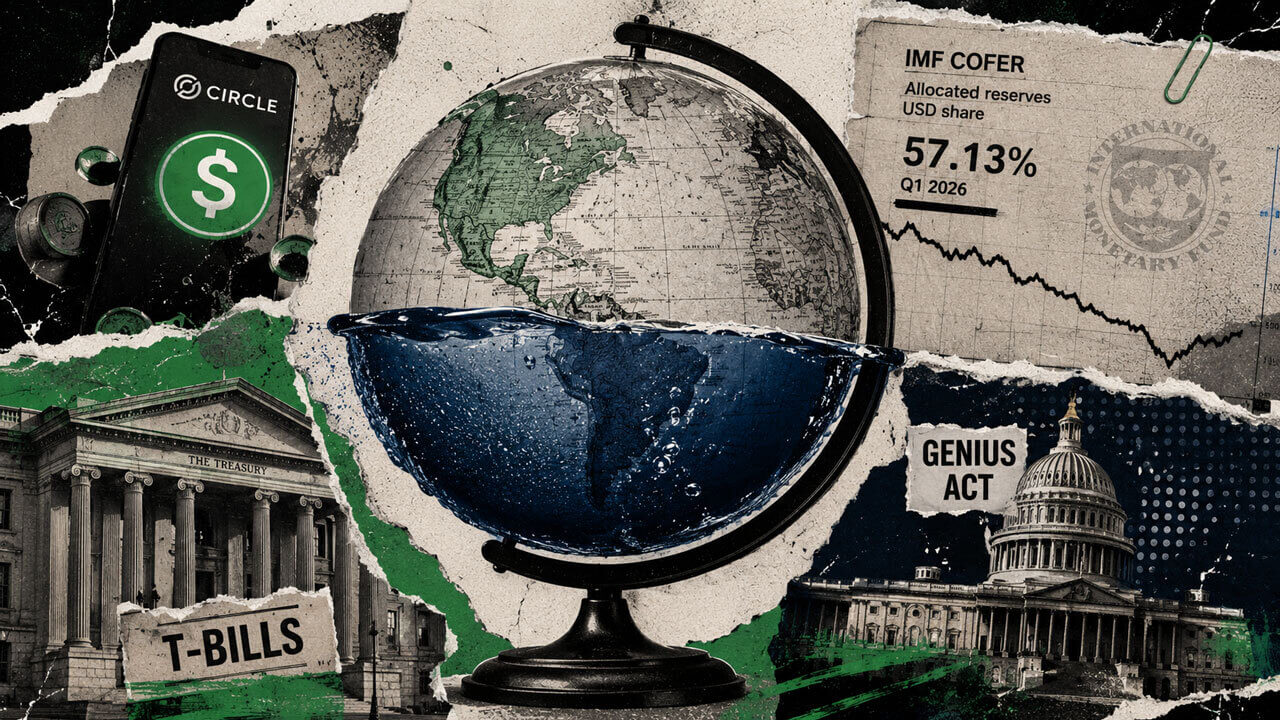
Circle president Heath Tarbert told Congress in September 2025 that placing digital-dollar infrastructure under US rules could reinforce networks supporting the currency's global role, framing stablecoin legislation as a tool of dollar statecraft.
Regulated stablecoins can change how issuers hold reserves and add demand for short-term Treasuries, but this growth operates separately from official central bank reserve allocations. The dollar accounted for 57.13% of allocated global foreign exchange reserves in the first quarter of 2026, up from 56.42% in the fourth quarter of 2025, according to the International Monetary Fund. However, exchange-rate valuation effects accounted for roughly half of that quarterly increase, and the longer-term trend shows a decline in the dollar's official reserve share.
Private Dollar Markets vs. Official Reserves
The Bank for International Settlements estimated that roughly 98% of stablecoin value is denominated in dollars, showing the dollar's dominance in private token markets. However, BIS researchers expect near-term effects to appear mainly in private stores of value and means of payment rather than in official reserve functions.
Tarbert acknowledged that payment technology cannot substitute for sound economic policy and that digital infrastructure cannot preserve dollar primacy on its own. Central banks remain responsible for deciding which currencies they hold.
Regulatory Framework and Reserve Requirements
The GENIUS Act, enacted in July 2025, requires one-to-one permitted reserves, redemption at par, disclosures, supervision, and financial-crime compliance. Its main requirements were expected to become generally effective January 18, 2027. The framework can govern backing, redemption, and supervision, leaving central bank currency allocations outside its scope.
A Treasury Borrowing Advisory Committee analysis through September 2025 found that Treasury bills represented 53% of Tether and Circle assets. Their bill holdings had increased by $70 billion since 2022. Despite this growth, stablecoin issuers held less than 1% of Treasuries outstanding.
Market Growth and Risks
The Federal Reserve staff estimated stablecoin market capitalization at $317 billion on April 6, 2026, more than 50% above its level in early 2025.
Fed staff warned that complex intermediation, vertical integration and deeper links to traditional finance can increase opacity and contagion. BIS researchers caution that broad adoption of dollar stablecoins could accelerate private currency substitution, weaken domestic monetary-policy traction, and redirect emerging markets' savings toward US Treasury bills. A run on a major issuer could transmit stress into local financial systems and short-term dollar markets.
Official reserve share remains determined by economic credibility, liquid market depth, institutions, policy, and valuation effects rather than stablecoin adoption.