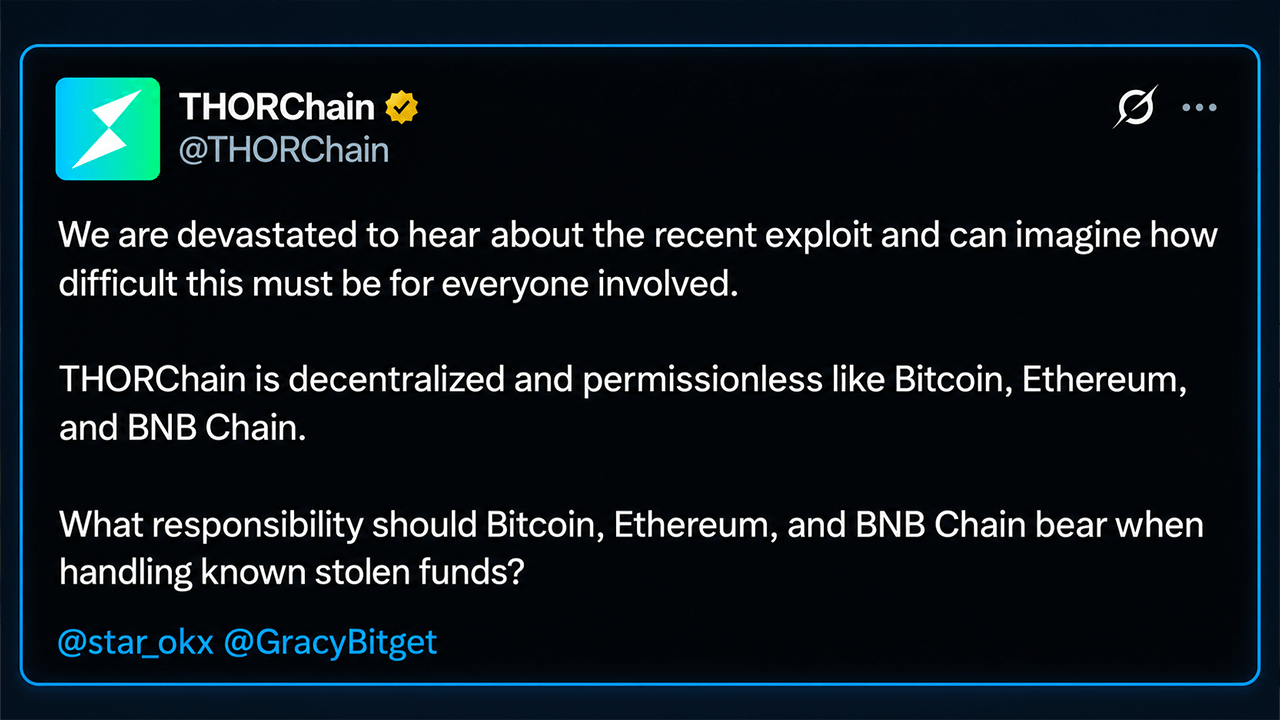
Following a $387.5 million theft from cryptocurrency exchange Bitget on September 24, CEO Gracy Chen requested that Thorchain, a decentralized exchange service, block addresses linked to the attacker. Thorchain declined the request, stating its protocol operates as a decentralized and permissionless system similar to Bitcoin, Ethereum, and BNB Chain.
Thorchain's response drew criticism from some crypto industry figures and support from others. Joel Valenzuela, business development and marketing lead for Dashpay, opposed Chen's request, arguing that no one asks Bitcoin or Ethereum to reverse transactions despite both networks having rolled back transactions in the past.
OKX founder Star Xu challenged Thorchain's characterization of itself as truly decentralized. Xu argued that Thorchain's validator model gives selected validators collective control over assets in its vaults, making it function as an intermediary rather than a base-layer consensus system like Bitcoin or Ethereum.
Xu pointed to Thorchain's response to its own May incident, when node operators paused the entire network for 13 hours after its vaults were compromised. "A network that can stop when its own funds are at risk, but refuses to do so when someone else's funds are at risk, is not 'like Bitcoin,'" Xu stated, noting that Bitcoin cannot be stopped.
This dispute echoes a prior incident in February 2025, when Bitget's peer Bybit was hacked for an estimated $1.2 billion. The funds were routed through Thorchain, reportedly by the North Korean Lazarus Group, despite FBI pressure on Thorchain to block the transactions. Bybit's founder Ben Zhou indicated his exchange would assist Bitget in tracing the stolen funds.