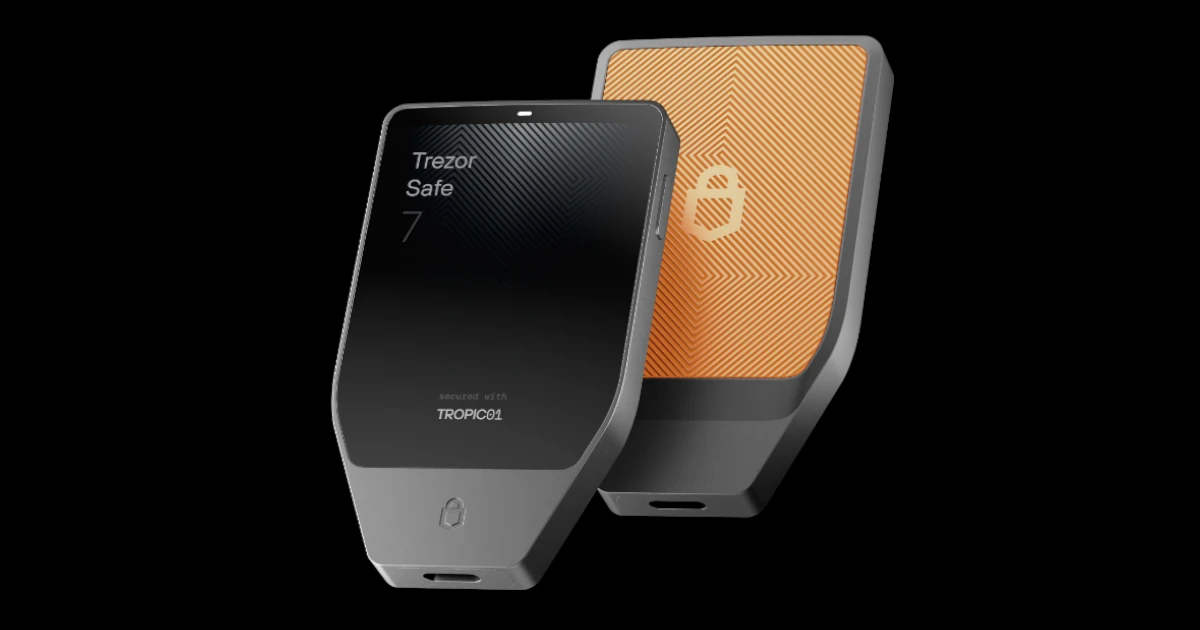
Trezor has released the Safe 7, a hardware wallet that bridges the divide between open-source principles and consumer-friendly design. The device features a metal exterior, edge-to-edge display, and tactile feedback mechanisms intended to make cryptocurrency self-custody more tangible to users.
The wallet offers two firmware configurations: a multi-coin universal version available in black and green, and a Bitcoin-only version in orange. Users can switch between firmware types regardless of which device color they purchase, though the Bitcoin-only version receives fewer updates since many firmware improvements target alternative cryptocurrencies.
Shamir Backup and Seed Recovery
A defining feature of the Safe 7 is its use of 20-word seed backups based on the SLIP-39 standard, which Trezor introduced in 2019. Unlike the more common 12 or 24-word standards, SLIP-39 enables Shamir Secret Sharing, allowing users to split their backup into multiple shares stored in separate locations.
In a three-of-five configuration, for example, a user could store three separate lists of 20 words in different physical locations. Loss of any single share would not compromise the wallet, but any three shares together can restore access. According to Trezor, the 20-word format uses the same 128 bits of entropy as 12-word seeds but employs a carefully curated word list designed to avoid confusion. SLIP-39 is supported by other wallets including Sparrow and Electrum, though adoption remains lower than the earlier BIP-39 standard.
Design and User Interface
The Safe 7 incorporates several design refinements over Trezor's earlier models. Approval actions such as transaction signing trigger a response sequence involving vibration, animated lights flowing around the screen border, and an accelerating mechanical sound that culminates in screen illumination. The device features larger on-screen buttons compared to the Model T, reducing the risk of PIN entry errors.
The wallet includes a Wipe PIN feature that deletes user data when entered during login, intended as protection against forced wallet access scenarios. However, Trezor's documentation does not fully explain the feature's intended use cases. Some users have noted that other hardware wallet implementations offer more sophisticated versions that open a decoy wallet without revealing the deletion to an attacker.
Wireless Connectivity and Battery
The Safe 7 marks the first Trezor model to include internal battery and Bluetooth capabilities. The device uses LiFePO₄ battery chemistry, which Trezor states is more stable and less prone to swelling than lithium-ion alternatives. It supports wireless charging via Qi2 and can operate over USB-C with Bluetooth disabled.
Adding wireless connectivity to a hardware wallet traditionally designed as air-gapped storage represents a departure from cold-storage principles. To address this, Trezor implemented the Trezor Host Protocol, which encrypts all data in transit whether sent via Bluetooth or USB-C cable, preventing the device from transmitting unencrypted information over either connection.
Operational Security and Data Breaches
Trezor's shipping partner ShipMonk experienced a data breach that compromised approximately 67,000 U.S. customer records. Many of these records should have been deleted by the shipping company according to Trezor. The company announced plans for an anonymous delivery service that will become available in the European Union within weeks and expand to the U.S. afterward.
Entropy and Implementation
The Safe 7 does not enable user-generated entropy input such as dice rolls during wallet creation. Users can add a passphrase or 25th word to existing accounts as an alternative. Trezor's Chief Technology Officer noted that user-generated entropy is only effective if firmware actually implements it correctly, citing a previous incident where a competitor's hardware entropy was rendered ineffective due to a software implementation error. Trezor's Chief Commercial Officer indicated the broader user base of Trezor cannot reliably perform entropy generation tasks and already experiences cognitive load from managing the 20-word seed.