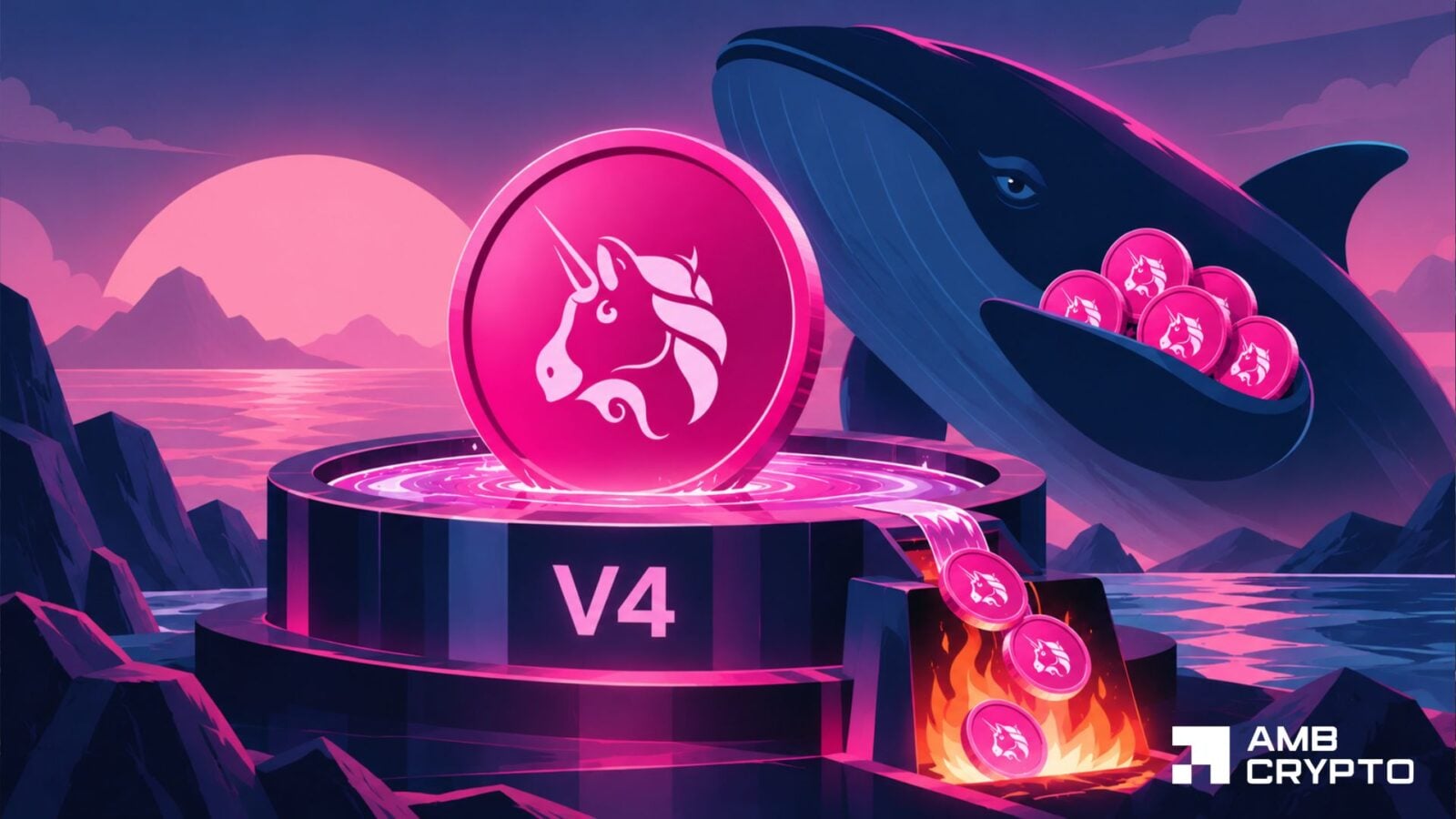
Uniswap V4 has emerged as the dominant venue for tokenized-stock trading, holding $59.1 million in liquidity as of the time of reporting. This represents approximately 31% of the total $192.6 million market for tokenized stocks across decentralized finance platforms.
Kamino follows with $41.7 million in liquidity, while Uniswap V3 holds $20.9 million. Together, these three platforms control 63% of total value locked in the tokenized-stock sector. The concentration reflects a broader shift toward newer infrastructure, with the sector's total liquidity up 2,218.8% overall.
Revenue Growth and Token Economics
Uniswap V4's increased trading activity has driven daily protocol revenue toward $600,000, translating to an annualized run rate near $220 million. V4 currently generates over $10 million in daily fees, substantially outpacing V3, which reportedly supports roughly $598,000 in daily burns.
This revenue growth carries implications for UNI token economics. Once Uniswap activates its fee switch mechanism, protocol revenue will be directed toward burning UNI tokens, reducing supply as trading activity expands. The extension of this mechanism to V4 could materially accelerate token removal given the platform's higher revenue generation.
Whale Positioning and Supply Dynamics
Large token holders have begun accumulating UNI amid the protocol's improving economics. BitMEX cofounder Arthur Hayes acquired 244,406 UNI tokens worth $1.73 million through over-the-counter channels, a move designed to limit immediate market impact. Fresh wallets added another $2.9 million in UNI during the same period, while exchange balances declined by more than 350,000 tokens.
These movements indicate net absorption of UNI rather than distribution, potentially tightening available supply as protocol-level burns remove additional tokens from circulation.