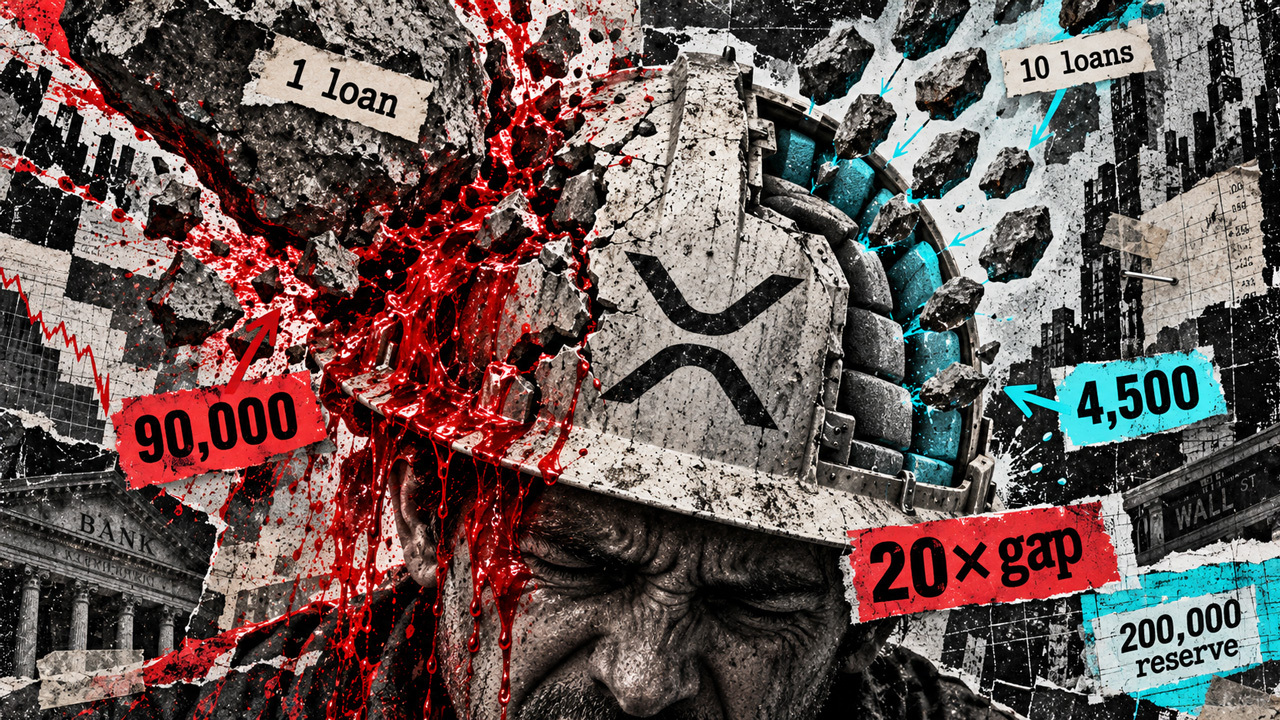
The XRP Ledger's documented lending model allocates default losses to depositors unequally depending on how a broker structures its loans, according to a comparison of two hypothetical loan books with identical starting conditions.
In a modeled scenario, a single 100,000-token default leaves depositors absorbing 90,000 tokens of loss. The same 100,000 tokens of bad debt distributed across ten smaller loans results in only 4,500 tokens of depositor loss—a 20-fold difference. Both loan books begin with 1 million tokens of debt, a 200,000-token reserve, and identical protection settings.
How the Reserve Coverage Works
The lending design pools assets in a vault and extends fixed-term, uncollateralized loans through a broker. Depositors hold shares in the vault, which loses value when assets suffer losses. The reserve protection operates through three parameters: the amount of reserve deposited, a minimum cover rate relative to the broker's total debt, and a liquidation rate determining how much of that minimum cover can be used per default.
With both rates set at 10% and 1 million tokens of broker debt, each default can trigger a maximum 10,000-token payment from the reserve. A 100,000-token loan therefore receives only 10,000 tokens of cover, leaving 90,000 tokens of loss for the vault.
The Loan Structure Effect
When the same 100,000 tokens default across ten 10,000-token loans instead, the calculation resets after each default. The first default draws 10,000 tokens; as broker debt drops to 990,000, the second draws 9,900 tokens. This pattern continues, with payouts decreasing each time and totaling 95,500 tokens across all ten defaults. Depositor losses total 4,500 tokens—90,000 less than in the single-loan scenario.
The reserve remains sufficient throughout both scenarios. After ten defaults, 104,500 tokens of cover remain, above the 90,000-token minimum required against remaining debt. The gap occurs without the broker depleting its reserve or falling below its required minimum.
Variables That Change Outcomes
Changing the liquidation rate produces different results across loan structures. At a 5% liquidation rate, a single large default produces 95,000 tokens of depositor loss versus 52,250 tokens across ten loans. At 20%, the single loan produces 80,000 tokens of loss while ten loans produce none in this model.
Simply increasing the reserve amount does not change outcomes in the base case because the per-default limit already constrains payouts. However, if available reserve falls below the calculated payment amount, it becomes an additional constraint.
Disclosure and Risk Assessment
The cover rates are set when a broker is created and cannot be changed thereafter. A broker's maximum debt can be limited, but this does not guarantee that any particular large default will be fully covered. Prospective lenders assessing protection would need to know both cover rates, available reserve, current debt, loan sizes, and borrower concentration.
Default timing rests with the broker, who must submit the default transaction after payment due dates and grace periods expire. Once a loan is defaulted, it cannot be defaulted again.
The comparison uses version 3.3.0 of the lending rules, announced August 6. Mainnet activation remained unconfirmed as of early September, with the amendment listed as in development. The figures are hypothetical and account only for the reserve calculation; actual economic outcomes could be affected by off-chain contractual support or later recoveries.