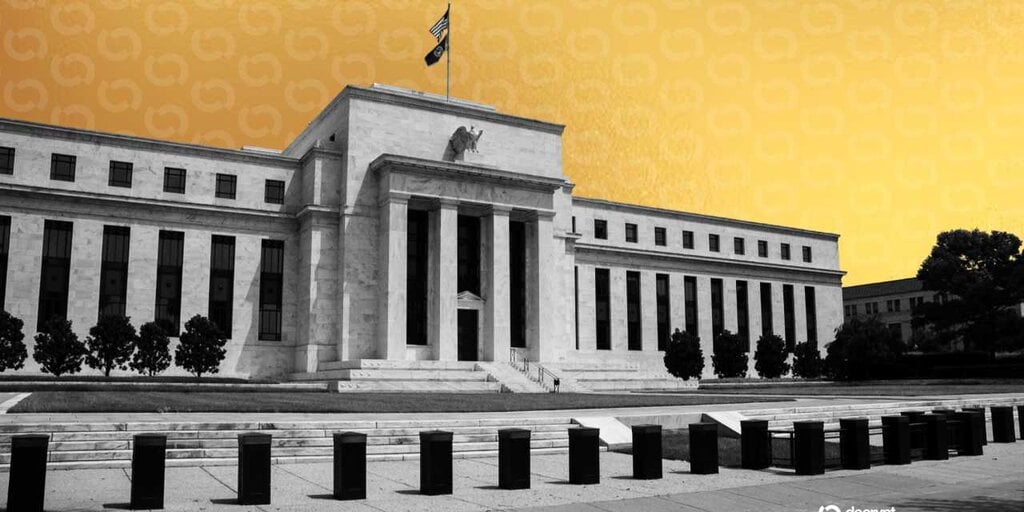
Federal Reserve Chair Kevin Warsh marked his 100th day in office by formally rejecting forward guidance—the Fed's long-standing practice of hinting at future interest rate moves. Speaking at the Kansas City Federal Reserve's Jackson Hole symposium, Warsh declared that forward guidance has "overstayed its welcome," arguing that when traders base decisions on Fed signals rather than economic data, markets lose sight of reality.
"Market participants will always try to anticipate what we will do next," Warsh said. "But we should not indulge a regime in which market participants are looking primarily to the Fed for their next trade."
The cryptocurrency market showed little reaction to the speech. Bitcoin remained flat on the day, hovering near $80,000 after a weekly rally exceeding 20% earlier in the week. The broader crypto market held steady around a $2.7 trillion market cap, down 0.2% on the day.
Warsh described the current dynamic as a "hall-of-mirrors problem," where the Fed and markets end up watching each other's expectations rather than focusing on underlying economic conditions. He noted that a more restrained Fed would be better positioned to meet its objectives.
Traders did experience a brief reaction to Warsh's comments on inflation. When he emphasized the Fed's "predominant focus" on inflation and suggested the central bank still has "work to do" to curb it, Bitcoin prices dipped roughly $1,000 before recovering almost immediately.
Inflation Remains Elevated
The Fed's preferred inflation measure, the PCE price index, is running at 3.7% annually—nearly double the Fed's 2% target. Warsh noted that 54% of the goods and services tracked by the Fed have posted price gains above 3% over the past year, down from post-pandemic highs but still well above pre-pandemic levels.
CME FedWatch data showed traders had significantly reduced expectations for a rate hike in September, cutting odds from 82% a month earlier to 38.4% before Warsh's speech. The next Fed rate decision is scheduled for September 15–16, alongside updated economic projections.
Bitcoin's recent strength has been driven primarily by Treasury Department debt buyback operations rather than Fed communications. With Warsh declining to provide forward guidance, traders face continued uncertainty heading into the September decision.